
Artificial intelligence in the swine industry: an unstoppable present
21-Dec-2023 (2 years 9 months 13 days ago)
Although artificial intelligence (AI) and its use in the swine industry has been a recurring theme for several years, this year, with the emergence of ChatGPT, we are all undoubtedly discovering the power of this technology and understanding the extent to which it can affect us, both at the organizational level and even at the personal level. In the next five years, AI will change many organizations' processes (for the better), it will erode the value of many types of jobs, and it will also create many new types of jobs. To adapt and make the most of this set of technologies, we need to understand how they work, their limits, and their applications, all of which we will try to clarify in the following article.
Machine learning or the importance of data quality
When we talk about AI, we refer to the ability of computers to do things that humans do especially well, such as speaking, reading, processing images, reasoning, planning, or sensing. To this end, under the umbrella of AI are the fields of knowledge that include mathematics, computer science, robotics, neuroscience, etc. But it is very important to understand that the whole revolution that we are experiencing surrounding AI is related to a very specific area of AI called Machine Learning. That is the ability to generate models from reality that learn from past data to predict the future. All the major advances we are seeing in AI in recent years, from ChatGPT, Computer Vision, or predictive modeling, are driven by the same tailwind: Machine Learning.
When we are surprised by an answer that ChatGPT gives us, we see a machine learning model at work, specifically Deep learning, which is within the many families of machine learning. This one is based on neural networks, more specifically the Transformer type, better known today as generative AI.
ChatGPT is possible because an algorithm, defined as a list of instructions to solve a calculation or an abstract problem, has been trained with a huge database of billions of texts extracted from the Internet. As we can see, big data (massive data processing) and machine learning go hand in hand, driving this revolution in the world of artificial intelligence.
I explain this because many times organizations are hungry to talk about artificial intelligence, but talking about data or concepts such as digitization, the cloud, big data, or the IoT (Internet of things) is less appealing to them.
A good data culture in the organization is a prerequisite for the application of artificial intelligence.
The four pillars that will allow us to feed this new generation of AI algorithms and get the most out of them are:
- Digitalization: the use of IT tools to manage our processes will lead us to transform procedures so that they leave a digital trace.
- The cloud (renting computing resources in the cloud, rather than buying them physically) will allow us greater flexibility in deploying new communications, storage, and computing resources.
- Big data (massive data processing) will allow us to process this data to leave it at the point where AI algorithms start to work.
- IoT (deployment of devices that measure and emit data) will allow us to set up all the sensors in our farms to collect important data such as temperature, humidity, animal weights, disease prevalence, etc.
What would be a good roadmap for AI implementation in the swine industry?
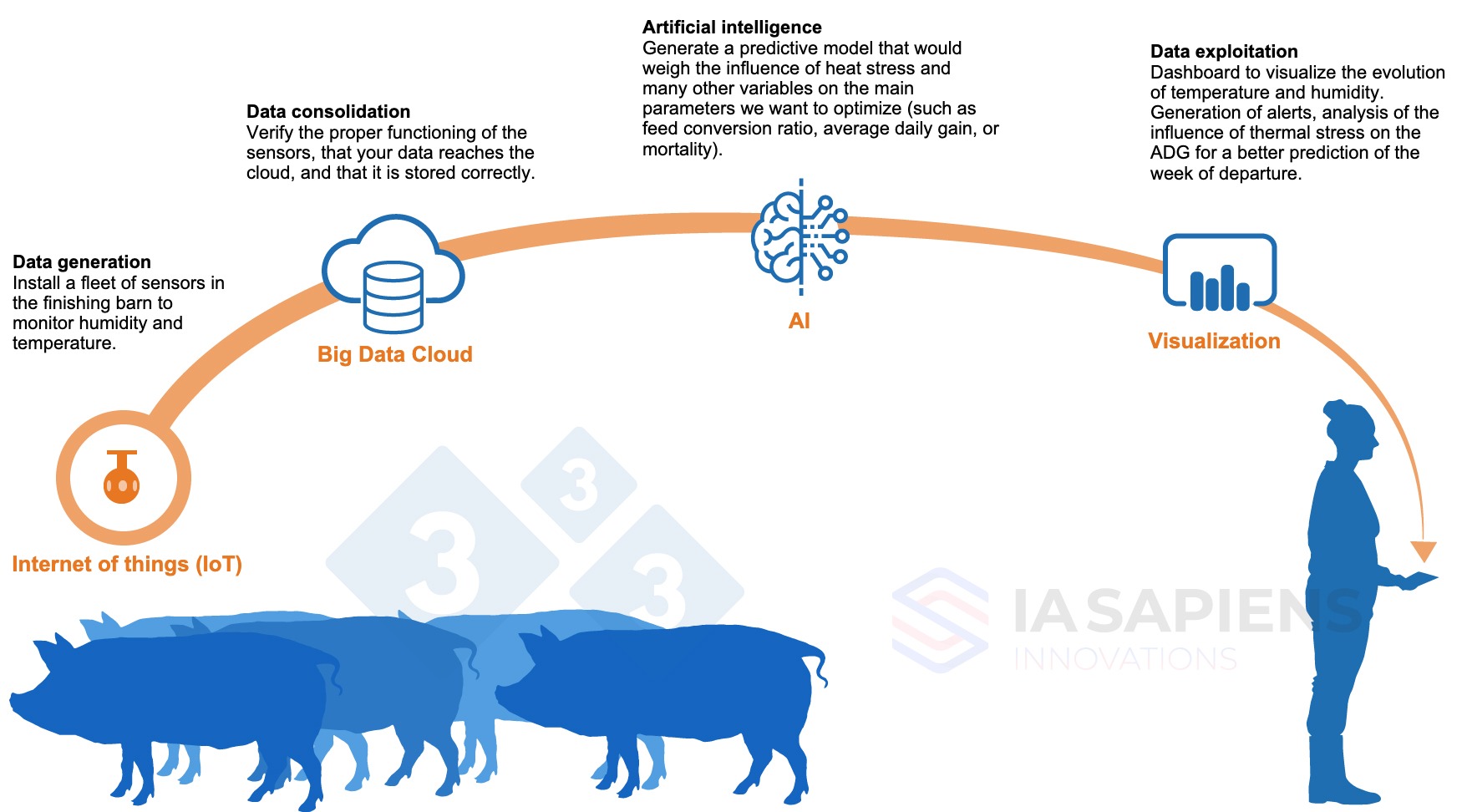
- Data generation. Transform my processes (digitization) and add new sensors (IoT), which will allow me to access new data to get the most out of AI. Figure 1 shows an example of AI implementation in finishing barns.
- Data consolidation. Adequately consolidate the data in a centralized repository, making use of technologies such as the cloud or big data if necessary.
- Data exploitation. Choose a business intelligence tool and use it to create a data culture within the organization, empowering the most advanced users as the spearhead of data analysis within the organization. Start generating useful alarms to correctly manage the operating bands of my organization at all levels (technical, operations, economic, etc.).
- Artificial intelligence. Apply AI to solve specific business questions. Start with narrow, very specific use cases, and modest questions, but clearly defined in terms of the data needed and the objectives to be achieved. Gradually apply the framework to more cross-cutting use cases until all the variables affecting our value chain are under control.
 Artificial intelligence is redefining the way we manage and optimize all aspects of production and is becoming the driver for smarter, more sustainable, and a more productive livestock industry. Implementing AI in the swine industry requires a significant investment in time, resources, and training. However, the potential benefits are enormous. Not only can we expect improvements in efficiency and productivity, but also advances in animal welfare and environmental sustainability. In addition, the creation of new jobs specializing in data management and analytics is an opportunity to revitalize the industry with a new generation of talent.
Looking ahead, it is essential that the industry not only embrace AI but also foster a culture of innovation and continuous learning. AI is not the end, but a tool that, together with human wisdom and experience in the field, can lead the swine industry into a prosperous and resilient future.