
Defining and improving biosecurity rings on a real farm
20-Sep-2022 (4 years 26 days ago)
In the current global production context of very low or even negative profit margins, high standards in terms of animal welfare, health status regarding endemic or notifiable diseases, and the control of antimicrobial resistance, monitoring biosecurity is becoming increasingly important but also complex at the same time.
As explained in the previous article, there are different in-depth ways of evaluating biosecurity on a farm. In this article we will introduce a new way called biosecurity in rings, and we'll include real examples.
To define the different rings present on a farm, the first thing we must do is understand their basis. To do so we must know at least the following:
- Animal entry and exit routes and procedures.
- Feed entry routes and procedures
- Personnel entry procedures and movements within the farm
- Carcass exit routes and procedures
- Entry and exit routes for other supplies (tools, materials, waste, etc.).
Using the information gathered in this first step along with the farm blueprints, we can depict the major movement routes for each of the above groups, as shown in Figure 1.
As seen in Figure 1, practically 100% of the entrances to the farm are through a single gate. This means that, when defining the rings (Figure 2), we find that only the fencing of the farm acts as a barrier for controlled entry (yellow ring). The agglomeration of routes at this gate facilitates cross-contamination of workers, animals, and vehicles, so that once inside the farm, no further effective barriers can be defined in this case.
Once the basic definition of the rings and routes is done, we must analyze and prioritize the opportunities for improvement for this farm. In this case, 3 practices stand out in particular:
- Gilt quarentine and entry. As seen in the maps of Figures 1 and 2, the gilts access the farm premises via the same loading bay used for the exit of animals and have to cross the corridors of barns holding animals. In addition, the quarantine area is the end of a building, a finishing barn in this case, in which the animals are managed by continuous flow.
- Loading bay for animal exit. One of the activities that generates more risk on a farm is located at the main entrance, as this is where also the carcasses come out, the feed truck comes in, etc.
- Personnel entrance. It is the only route that enters at a different location, however, personnel must pass through the area where routes cross in order to enter and exit the changing room.
What would be the main objectives in this case?
- Separate routes in order to "clear" the farm entrance of movement.
- Effectively isolate gilts
The top priority is to achieve our objectives using the simplest possible improvements:
- Gilts. Why have these sows at the end of a finishing barn when there is a small building at the top lefthand corner of the farm? These animals should be relocated, switched to all-in all-out management, and have their own entrance to get them off the truck without them crossing through any barns.
- Exit loading bay. This is similar to the previous case in that, instead of moving animals through all the buildings and loading them in a crossing area, the loading bay can be relocated to the back of the farm, close to the finishing area.
- Constructing a double fence. Fortunately, the farm has enough space between the buildings and the outside fence to build a double fence that clearly separates an extra clean area (white, in Figure 4) through which the workers can move without encountering any outside vehicles: carcass pickup, supplies, etc.
- A footwear change (from street shoes to transition) is added for the workers to access the white zone on their usual route from the outside until the main changing room can be relocated.
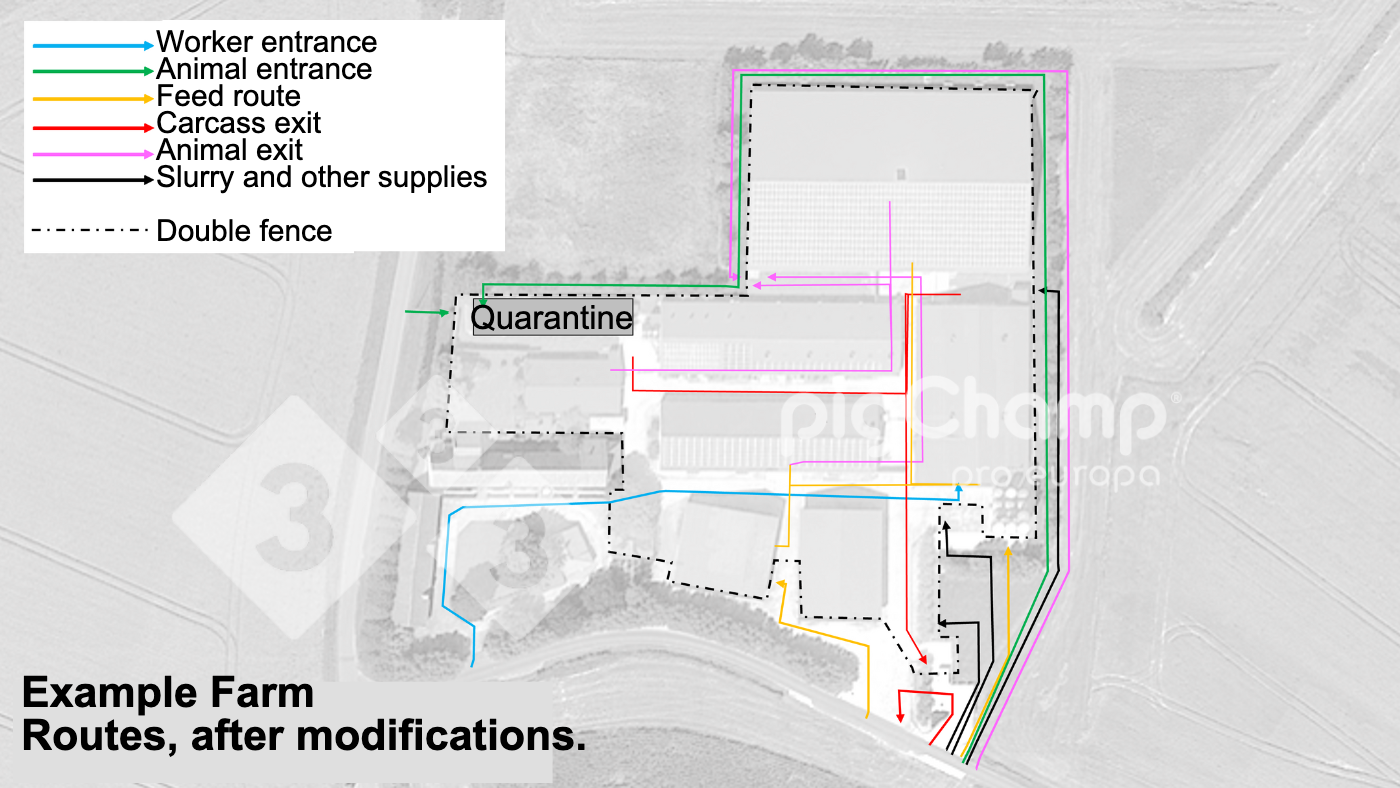
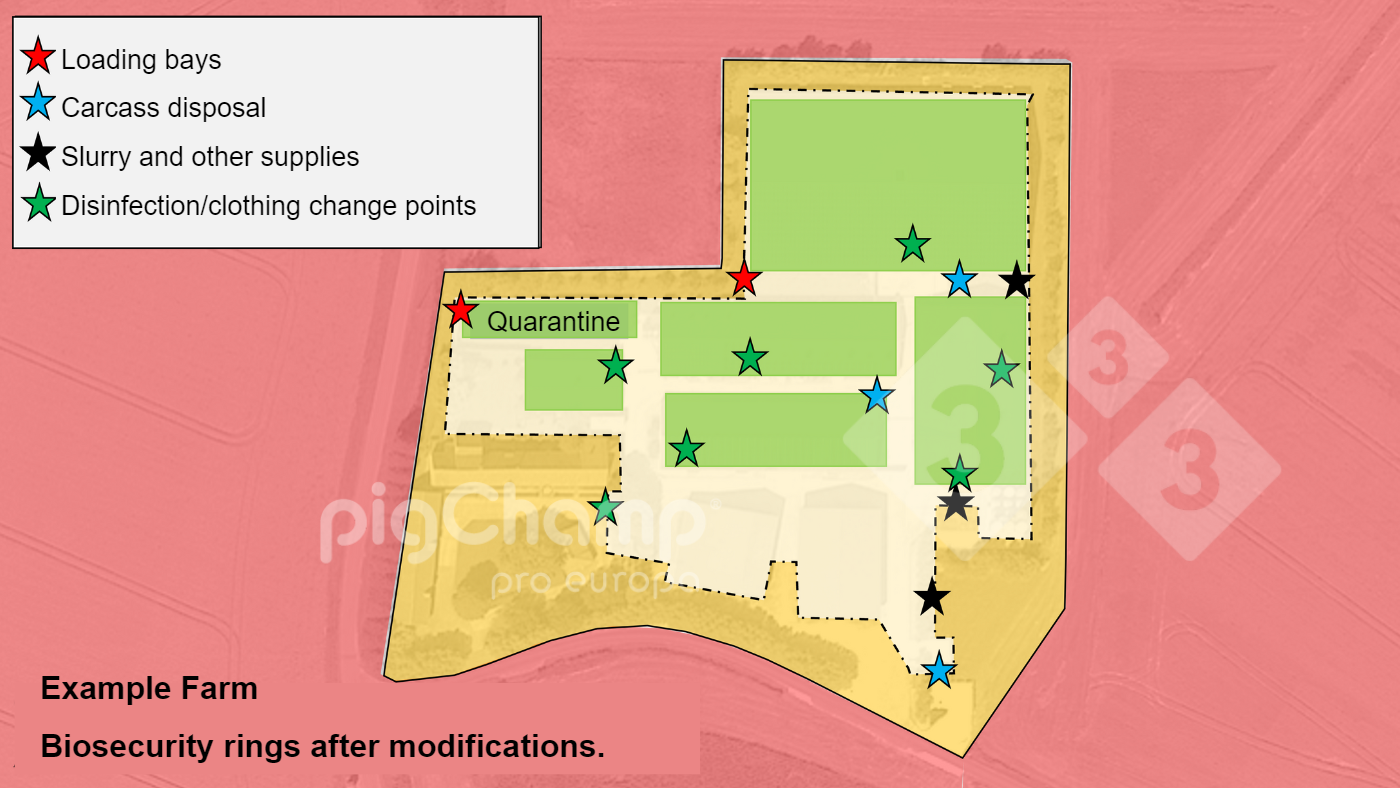 With just three changes, albeit important ones, it is possible to significantly reduce the crossing of routes and, above all, to create an extra biosecurity ring with well-defined clean and dirty zones for workers, animals, and vehicles.
The biosecurity ring analysis method is adaptable to any type of farm, from the most complex to the simplest, offering a very precise overall picture of the risk that helps us to make decisions in a structured and rational way.