
New approaches to age-old problems in nursery piglets
08-Mar-2021 (5 years 6 months 10 days ago)
In recent years, together with the increase in piglets weaned per sow per year, there has been a worsening of nursery performance indicators in two areas:
- Increased mortality
- Greater % of poor quality weaned pigs which will perform worse in the finishing phase.
Most common problems affecting nursery piglets.
- Porcine streptococcus, either in its acute form causing meningitis and death, or in its localized form with increased inflammation in the joints.
- Enteric problems caused by E. coli: with the ban on zinc oxide there has been an increase in digestive problems, also influenced by the quality of the piglet, the quality of the water and the conditions of the nursery facilities.
- Enteric [disease caused by rotavirus or other viruses, which often persist in the facilities, even after washing.
- Post-weaning syndrome tends to appear more frequently linked to the variability of weaning weights, and to having a greater number of lower weight piglets, which struggle more to have an adequate feed intake in the first days post-weaning.
- Glasser's disease: Disease associated with fever and polyserositis (pericarditis, inflammation of the serous membranes with high presence of fibrin.) The animals appear listless, pale. Lameness and coughing are very frequent.
Below are the risk factors and control measures for each problem, as well as general control measures for this phase.
Porcine streptococcus

Risk factors and their correction
- Coinfection with PRRS limits the clearance capacity of streptococci at the pulmonary level, therefore, the impact of streptococcus is very powerful in animals in which the PRRS virus recirculates in the nursery stage.
- Ventilation management, minimal ventilation, incorrect air volume renewal is a risk factor for the clinical presentation of the disease. Control of airflow at an early age.
- Densities. Incorrect densities can increase the degree of stress and can be a predisposing factor for the development [of the disease].
- Improper cleaning and disinfection of the facilities. Environmental infection pressure is a risk factor.
- Diarrhea in the farrowing and nursery phases leads to intestinal inflammation and consequently to pathogen penetration (intestinal barrier failure).
- In farrowing, tail docking is a route of entry, use cauterizers.
The approach should be aimed at correcting the risk factors and stabilizing sow health, and therefore the nursery.
Colibacillosis

Risk factors for presentation in the nursery
- Abrupt temperature changes: variations of 10 Cº and/or low temperatures increase the clinical presentation of the disease.
- Quality of drinking water: Water with a conductivity above 1500 microsiemens is usually a predisposing factor. The water must be of good quality- microbiologically and physicochemically.
- Feed digestibility and palatability: reducing the time of anorexia is of vital importance. Providing feed in mats or dishes can ensure early feed intake.
Antibiotic treatments in the farrowing house, if antibiotic treatments have been given at the lactation phase, this results in a change in the intestinal microbiota and probably alters the integrity of the intestinal barrier.
Post-weaning syndrome
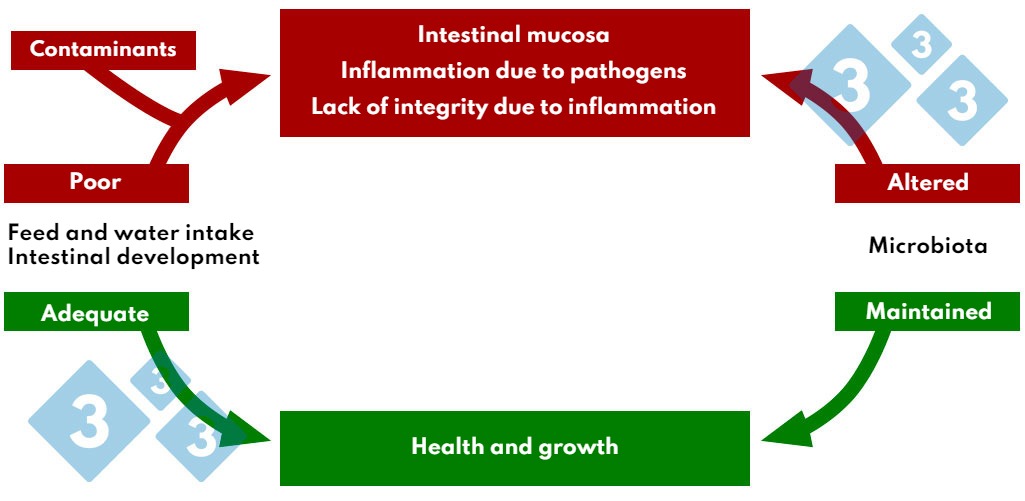
 Due to the drop in feed intake at weaning, piglets lose weight and any intestinal pathogen can colonize the piglet leading to pathological processes resulting in developmental failure. The drop in feed intake at weaning results in atrophy of the intestinal villi, as they need nutrients in the intestinal lumen.
Factors to consider:
- Hygiene of the facilities: pathogens such as rotaviruses and coronaviruses, which often persist if washing is not done correctly, often lead to loss of the villi and therefore to malabsorption syndrome.
- Temperature at piglet entry: Low temperatures will lead to low feed intake and diarrhea. Ensure 26-28ºC at entry.
- CO2 monitoring, if high due to inadequate minimum ventilation, causes a loss in intake.
- Drinker control: with good flow rates that allow adequate water consumption.
- Quality of drinking water, piglets do not eat if they do not drink enough beforehand. Microbiological quality as well as physicochemical quality should be considered. If the water is of good physicochemical quality, the use of sweeteners or flavorings does not improve water consumption.
- Use of mat feeding or dishes in the pens to increase feed intake and give piglets a good start, as we limit the negative effects of anorexia on the piglets.
Glässer's disease
Risk factors:
- Poor ventilation that causes poor renewal of air and a concentration of gasses.
- Increase in stocking density.
- Concomitant viral diseases (PRRS, influenza).
- Mixing animals of different ages.
Control measures:
- Managing animal flows is very important to achieve the health stability of the nursery. Mixing ages and continuous cycles are often reasons for an increase in the severity of the disease.
- Stabilize breeding sows against PRRS and influenza, since virus recirculations in the nursery phase significantly increase the incidence of the disease.
- Animal density and poor ventilation, are factors that create high stress and therefore increase clinical presentation.
General control measures that are increasingly more important to minimize problems in the nursery:
- Facility hygiene and monitoring of its practical implementation to reduce infection pressure.
- Environmental control with ventilation management, focusing on controlling minimum temperatures, allowing proper air renewal and maintaining the appropriate temperature.
- Reduce antibiotics in the farrowing phase. The diversity of the intestinal microbiota helps maintain the integrity of the intestinal barrier.
- The intestinal microbiota is a complex dynamic ecosystem, which can be altered by numerous causes, with the main ones being stress, disease, antibiotic treatments, etc. Elements that affect the microbiota in one phase will take their toll in the next phase. For example, effects on the microbiota in farrowing will affect performance in the nursery.
- Stimulate early feed consumption: anorexia is a determining factor in increasing intestinal permeability and reducing nutrient absorption.
- Provide drinkers that maximize water intake; If the piglets don't have a good water intake, they do not eat.
- The All In-All Out approach is becoming increasingly important in order to break the epidemiological chain of the different diseases (management of animal flow).
Problems in the nursery must be prevented and treated in a comprehensive manner considering pathology, nutrition, management, facilities, flows, etc.