
Anestrus in gilts
16-Feb-2021 (5 years 7 months 25 days ago)
In order to start a reproductive cycle, it is essential that sows show signs of estrus so that they can be inseminated and begin a new gestation. Whether we are talking about gilts or weaned sows, there is always a small percentage of animals that do not show signs of estrus or they show them late with respect to what would be normal. If they do not show signs of heat, the problem is serious, since it would not be possible to start a reproductive cycle; but if they show delayed signs of heat (usually this happens after weaning), the problem is that it affects the structure of the batches and, therefore, the number of farrowings that will be achieved in each one of them, in addition to increasing the production costs by having a percentage of non productive sows on the farm.
A lack of estrus can be presented by gilts or multiparous sows, and we are going to analyze this separately in two articles. When it affects gilts, it is considered one of the frequent causes of culling, which increases the need for gilts and their cost because while we wait for them to show signs of estrus, the days go by and the gilts continue eating.
Anestrous gilts are those that have not shown signs of estrus at 220 days of age. Gilts should be pubertal between 180 and 210 days of age, and we understand puberty as the first expression of estrus. It is considered acceptable to have up to 10% of gilts that may be delayed in this first coming into heat.
When the percentage of gilts that do not reach puberty is higher than 10%, an investigation should be started to find out what the causes are and, consequently, to establish corrective measures.
The first step in diagnosing the cause is to find out if the ovaries are actually inactive or are already cycling; to do so we can perform an inspection in the slaughterhouse. Another way to check would be to measure serum progesterone levels, which are highest in the luteal phase of the estrous cycle and therefore cycling.
Inactive ovaries
We would be facing a problem of delayed puberty and therefore it would be necessary to review all the factors that may be responsible for this delay:
- Low growth during their rearing phase. Growth of less than 550 g/day has been associated with delayed puberty.
- Lack of fat. Leptin is a hormone produced by adipocytes, which plays an important role in regulating energy balance. High concentrations of leptin act positively on the release of GnRH and, consequently, on the stimulation of the pituitary gland and subsequent release of FSH and LH hormones, which will be responsible for ovarian activity. Lack of fat would reduce circulating levels of leptin, exerting a negative effect on puberty. Since the genotypes have increased their lean percentage, the gilts subjected to severe rationing could see their puberty impaired.
- Cold, humidity, drafts. Situations that lead to a use of fat reserves will not favor puberty.
- Lack of stimulation. The presence of the boar is the most powerful stimulus for the onset of puberty. Once the gilts have reached 180 days of age and are stimulated daily by the presence of the boar, they should come into estrus within about 10 days. Some of the reasons for boar contact not having the desired effect are discussed below.
- Irregular contact with boar
- Contact in the presence of an excessively large group of gilts
- Lack of light
- Excessive competition
- Genetic causes. Some genetic problems have been detected that would be related to a poor release of GnRH.
Active ovaries
In the case of having active ovaries, we would be facing a heat detection problem or silent estrus (with little expression of estrus).
In such a case, it will be necessary to review:
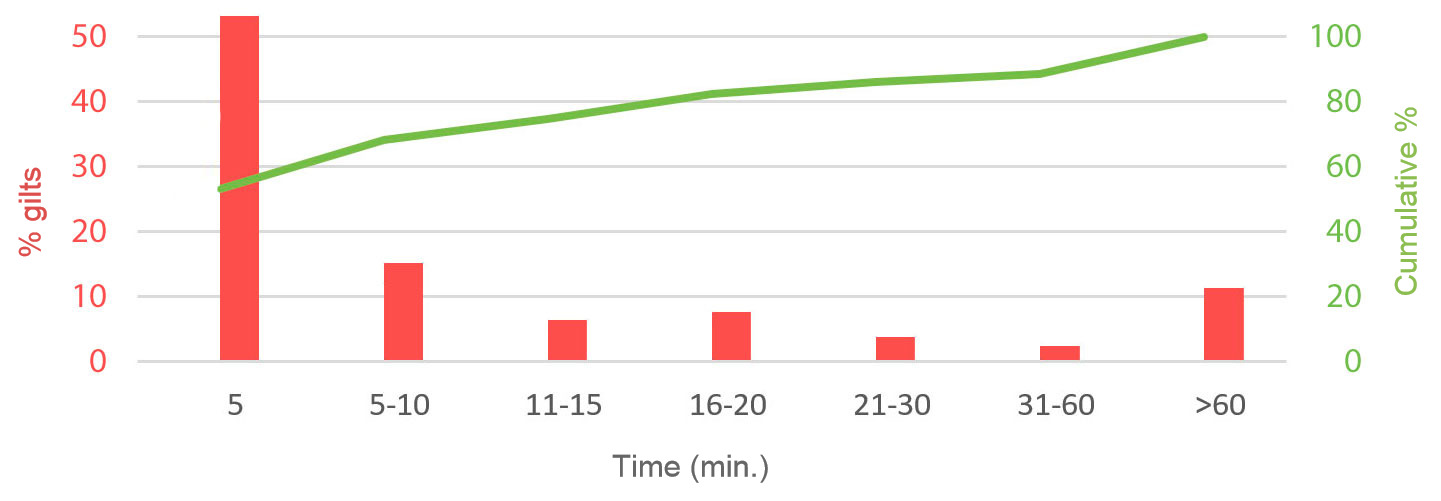
- Boar stimulation: Contact should be daily and irregular (about 15-20 minutes/day). Avoid keeping the growing gilts in direct and continuous contact with the boar, as this can lead to situations in which the gilts get used to the boar and subsequently lead to a loss of stimulation. Contact with the boar must be direct to be effective.
- Environmental conditions: Avoid cold, heat, excessive humidity or drafts that influence normal behavior.
- Size of group: Small groups of 4-6 animals are ideal, without mixing with multiparous sows.
- Proper feeding: frequently, gestation feed is given, which is very poor in protein and energy for gilt that is still growing.