Causes of regular returns to estrus: the sow
29-Dec-2020 (5 years 9 months 6 days ago)
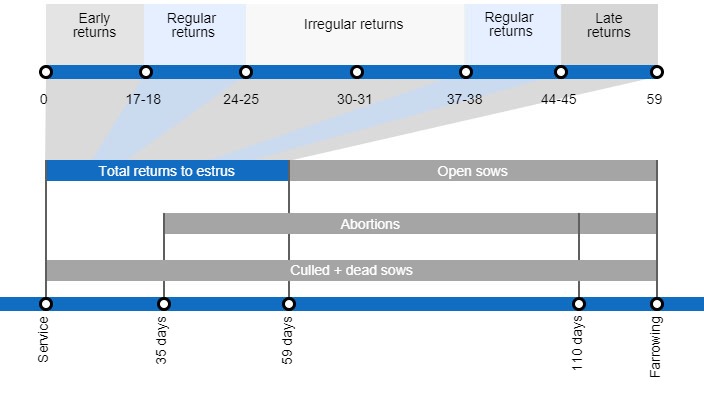
Regular returns to estrus occur 18 - 24 days and 38 - 44 days post-service. A sow has a regular return (maintaining the normal duration of an estrous cycle: 18-24 days or its multiples) when fertilization of the eggs has failed or when all fertilized embryos have been lost within the first half of the estrous cycle (<10-12 days).
Under normal conditions these should make up a very small percentage of the matings, < 5%.
Sow-related causes
Management
1. Lactation length: Lactations shorter than 21 days predispose first parity sows to regular returns, and in multiparous sows the same is true for a lactation length less than 16 days.
Table 1. Sow-related factors that influence farrowing rate. Koketsu, Y. 1997
| Lactation length (d) |
n | Farrowing rate ± SE (sow level) |
Farrowing rate ± SE (farm level) |
|---|---|---|---|
| 8-10 | 146 | 79.7 ± 3.3cd | 79.8 ± 5.1c |
| 11-13 | 1005 | 80 ±1.2c | 81.7 ± 3.1cd |
| 14-16 | 1195 | 84.4 ± 0.6cd | 83.6 ± 2.3cd |
| 17-19 | 2749 | 83.9 ± 0.7cd | 84.7 ± 2.3cd |
| 20-22 | 2003 | 89.1 ± 0.7de | 88.1± 2.7cd |
| 23-28 | 682 | 91 ± 1.1e | 90.2 ± 2.5dd |
2. Recurring returns: Each time a sow returns and is serviced, she is more likely to return than when was serviced previously (the farrowing rate is estimated to be reduced by 10%). It is important to cull sows with more than two returns to estrus.
Table 2. Data from 106 comercial farms. Carlos Piñeiro. 2007
| Total | 1st service | 1st return | 2nd (or more) return |
|---|---|---|---|
| Number of matings | 131,650 | 16,295 | 4,678 |
| Total number of matings in the study | 116,172 | 14,387 | 4,220 |
| Returns | 14,525 | 3,374 | 1,108 |
| % Returns | 12.5 | 23.5 | 26.3 |
| Number of farrowings | 91,153 | 8,713 | 1,780 |
| Fertility (%) | 84.4 | 68.1 | 52.2 |
| Farrowing rate (%) | 78.5 | 60.6 | 42.2 |
| Adjusted farrowing rate (%) | 82.4 | 66.4 | 52.7 |
| Total born | 12.1 | 12.0 | 11.6 |
3. Wean to service interval: Sows serviced late after weaning (7 - 12 days post-weaning) are usually less fertile.
Table 3. Fertility according to the wean to service interval. Koketsu, Y. 1997.
| Wean to service interval (d) |
n | Farrowing rate ± SE (sow level) |
Farrowing rate ± SE (farm level) |
|---|---|---|---|
| 1-6 | 6299 | 86.6 ± 0.4c | 87.6 ± 1.9c |
| 7-12 | 1333 | 81.8 ± 1.1d | 76.1 ± 4.4d |
| ≥ 13 | 900 | 85.4 ± 1.2c | 85.4 ± 2.4c |
4. Post-insemination management: Stress, in all its forms, can be one of the causes of sows having a regular return to estrus. Two times are especially critical:
- The first 30 minutes post-insemination. Stress during this time will block the oxytocin, responsible for sperm transport, which can affect the correct fertilization of the ova.
- The first 10-12 days post-service (may be heat stress). At this time stress can easily affect the correct implantation of the embryos leading to the loss of gestation.
Table 4. Influence of post-AI management. Flowers, B. 1996
| Frequency | Farrowing rate (%) | Born alive | |
|---|---|---|---|
| Mixing sows | 8//19 | -7 | -1.8 |
| Moving sows | 7/19 | -10 | -1.2 |
Overfeeding during the first 72 hours post-service can cause returns by reducing the levels of progesterone needed to maintain gestation.
Table 5. Effect of feeding level on embryonic survival. Aherne & Kirkwood. 1985
| Feed rate | Embryonic survival | Progesterone | ||
|---|---|---|---|---|
| d1-3 | d3-15 | d28 | ng/ml | |
| 1.9 kg | 1.9 kg | 12.4 | 86 % | 10.5 |
| 2.5 kg | 1.9 kg | 11.5 | 77 % | 3.7 |
| 2.6 kg | 2.6 kg | 10.2 | 67 % | 4.5 |
Body condition
1. Sows that have lost more than 2 body condition points during lactation are more likely to return to estrus.
Table 6. Relationship between average intake during lactation and farrowing rate. Koketsu, Y. 1997.
| Average feed intake, lactation (kg.) |
n | Farrowing rate ± SE (sow level) |
Farrowing rate ± SE (farm level) |
|---|---|---|---|
| ≤ 4.2 | 2068 | 83.2 ± 0.8c | 83.6 ± 2.5 |
| 4.2-5.7 | 4642 | 85.8 ± 0.5d | 85.3 ± 2.4 |
| ≥ 5.7 | 2252 | 84.8 ± 0.8d | 88.5 ± 2.3 |
2. Lameness, lesions: sows that are serviced being at a sub-optimal condition are more likely to return (Photo 1).

3. Toxicity or deficiencies: Lack of vitamins or amino acids, or presence of mycotoxins.
See the semen/boar-related causes for regular returns 
Use the button above or the flowchart to continue troubleshooting the returns, or to access other parts of the tool.