COVID-19 persistence on different materials practical implications
25-Mar-2020 (6 years 6 months 18 days ago)
Commented article
Aerosol and Surface Stability of SARS-CoV-2 as Compared with SARS-CoV-1. Letter published on March 17, 2020, at NEJM.org by Dr. van Doremalen, Mr. Bushmaker, and Mr. Morris. DOI: 10.1056/NEJMc2004973
Read the article summary
Comment
Farm biosecurity is key to preventing the entrance of new pathogens and preventing pig diseases. Pig diseases reduce, in general, farm profitability and this is the main reason why we want them out of our premises. But human diseases can also be devastating for farm profitability, especially when they are contagious. This is the case with SARS-CoV-2 infection in humans (Covid-19). Covid-19 can put the human teams on our farms at risk. The review on coronavirus persistence on different materials and in aerosols can help us implement measures on swine farms to reduce the human risk of infection. Based on the knowledge we have today, we can divide the measures into two types: external and internal biosecurity measures.
External biosecurity
The basic rule in these circumstances is to avoid the entrance of any visitors on the farm unless they are essential for maintaining normal operation. If visitors have to come on the farm, the minimum biosecurity standard should be:
-
Leave shoes outside changing rooms.
-
Take out external clothes.
-
Clean hands with soap for at least 20 seconds and disinfect them after.
-
Supply work overalls, boots, and protective mask. The protective mask will prevent aerosols produced by a possible positive asymptomatic visitor from infecting other workers on the farm. A FFP1 mask (mask with an aerosol filtration) would be enough to contain the possible infected aerosols inside the mask, preventing contamination of other people or farm material which could later act as fomites. The mask should be discarded once the visitor has left the farm.
But a farm also needs to introduce materials which someone has to bring into the facilities such as: semen doses, medication, ear tags, markers… Those materials can be contaminated by infected aerosols and they have to be considered as possible sources of infection. Here we will describe some easy to apply procedures which can help in reducing risk.
- An storage unit accessible from the outside perimeter fence will allow couriers to deliver semen doses without coming into contact with anyone on the farm. Asking the different semen supply companies to deliver semen doses inside two plastic bags allows one to remove the contents and throw away the external plastic when semen doses are taken from the reception refrigerator (remember: SARS-CoV-2 can be viable on plastic up to 72 hours, depending on environmental conditions). The handle of the storage unit and its interior should be disinfected each time the doses are collected. Farm personnel should use disposable gloves during this process or disinfect hands afterwards. In this way, semen doses can be introduced safely into the farm storage unit.
- A quarantine reception room can be provided where materials delivered to the farm can be placed to disinfect them before they are introduced, or if disinfection is not possible to leave them in quarantine for at least 2 days. Most of the material is delivered to the farm inside cardboard boxes. We have seen in the review that the virus can remain viable for several hours in cardboard and previous studies of permanence of SARS-CoV virus on paper speak for up to 5 days, therefore, a quarantine of two days will be advisable to reduce the risk. But, it would be even better if the material is taken out of the cardboard boxes and the boxes are discarded, not introducing them into the main herd. Ideally quarantine reception room should be divided in two areas (clean and dirty) separated by a counter or shelving. If disinfection has not been done, counter or shelving surfaces should be disinfected after the material has been removed.
- Virus can remain on paper for a few hours, therefore if documents from outside have to be signed at the communication window, the use of protective gloves is recommended. If this is not possible, hands should be disinfected afterwards. Concentrated alcohol (>70%) solutions will be effective.
- In case large materials (sow crates, construction material, fans, etc.) have to be introduced, providing a surface close to the perimeter fence, which could be disinfected and leaving the material for several days in quarantine (4-5 days) will also reduce the risk of virus introduction. The duration of quarantine can be reduced if material can be disinfected.
Internal biosecurity
Not all people infected by SARS-CoV-2 have developed clinical signs; a large proportion of infected people have been asymptomatic. An asymptomatic infected farm worker can shed the virus through aerosols and infect other people or contaminate materials. The following measures aim to reduce contagion among workers.
-
Establishing groups of workers by area or location on the farm. The groups must be carried out in such a way that there is no contact between them and physical separations can be established.
-
If possible, supply FFP1 masks to workers as this will reduce the risk of spreading aerosols.
-
Stagger the entrances and exits of work shifts to reduce contact between workers.
-
Do not share glasses or cutlery. Clean them with hot water and soap after every use. Ideally clean them using a dishwasher.
-
Take turns using the common areas. Clean and disinfect the floor after each use. Bleach solution 1:50 (20 ml bleach: 1 liter of water) is a good and cheap disinfection against Coronavirus. Bleach solution can also be used to disinfect frequently touched surfaces: tables and chairs, desks, worktables, doorknobs, toilet surfaces, water taps, etc. Remember that masks will be removed when people drink or eat, so common areas at the highest risk of remaining contaminated if there is a positive Covid-19 worker.
|
Summary of the commented article
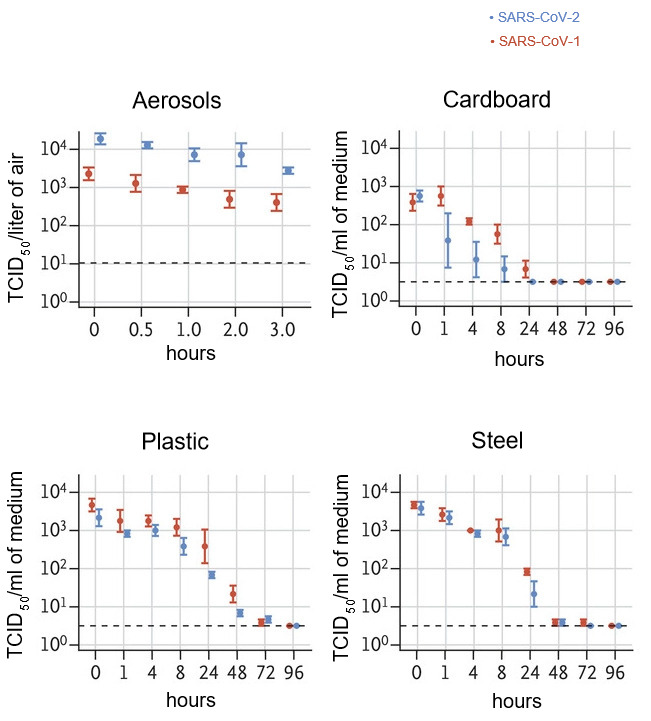
The data consisted of 10 experimental conditions involving two viruses (SARS-CoV-2 and SARS-CoV-1) in five environmental conditions (aerosols, plastic, stainless steel, copper, and cardboard) kept at 21-23°C and 65% hrelative humidity. Stability on aerosols: SARS-CoV-2 remained viable in aerosols for the length of the experiment (3 hours) with a reduction in infectious titer from 103.5 to 102.7 TCID50/L. Coronavirus persistence in materials Plastic: SARS-CoV-2 remained viable in plastic after 72 hours (from 103.7 to 100.6 TCID50/mL) Steel: SARS-CoV-2 remained viable in stainless steel after 72 hours (from 103.7 to 100.6 TCID50/mL ) with a median half-life estimate that was roughly 5.6 hours. Cardboard: No viable SARS-CoV-2 was measured after 24 hours but results must be interpreted with caution as they were very variable.
The study found that the stability of SARS-CoV-2 was similar to that of SARS-CoV-1 under the experimental circumstances tested. The results indicate that aerosol and fomite transmission of SARS-CoV-2 is plausible, since the virus can remain viable and infectious in aerosols for hours and on surfaces up to days (depending on the inoculum shed). These findings echo those with SARS-CoV-1, in which these forms of transmission were associated with nosocomial spread and super-spreading events, and they provide information for pandemic mitigation efforts. |