
How can farm production be increased with the use of Supersows?
25-Jun-2018 (8 years 3 months 23 days ago)
In previous articles, we talked about the existence of a special population within the farms: the supersows.
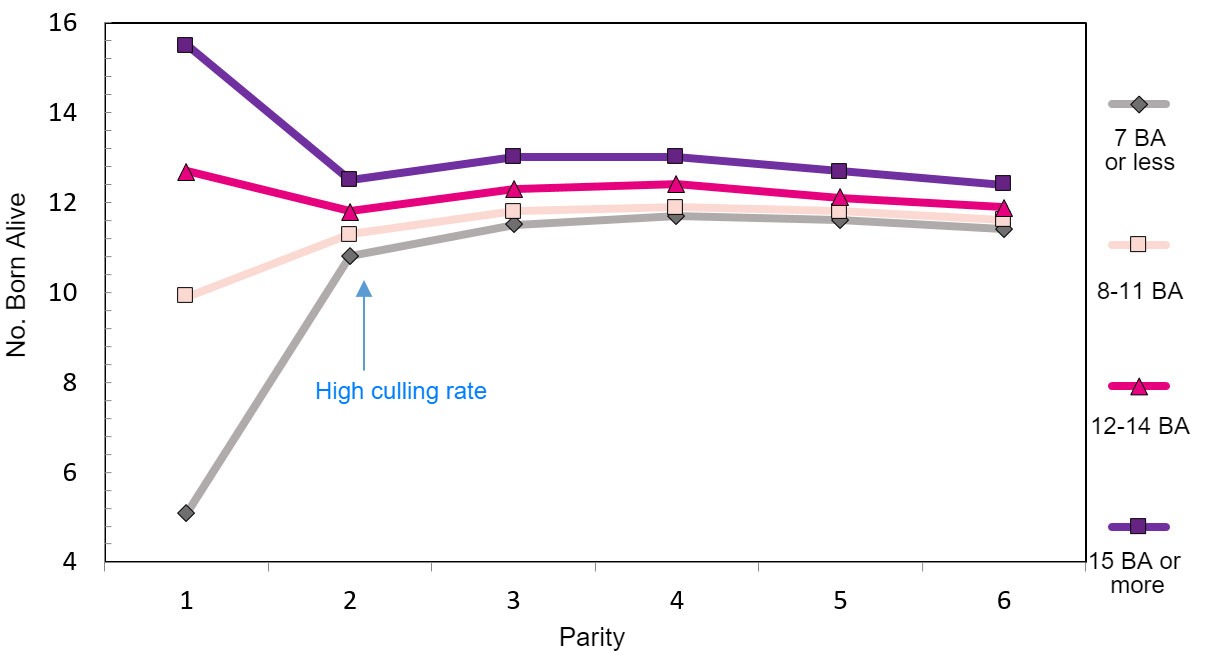
These sows have a special characteristic that differentiates them from the rest of the census: in their first farrowing they have more than 15 piglets born alive and they are more productive throughout their lives, with a higher number of total born and born alive, better farrowing rates and longer longevity.
How can we increase the number of supersows on the farm?
The status of supersow is not given by the animal’s genetic type. In fact, these populations have been found in the main white pig genetic that have been studied, which shows that maximizing the sows’ potential "simply" depends on an adequate management of the nulliparous sow.
We all know the sow’s first farrowing is crucial and yet, it is one of the most neglected aspects of the farm. Many more efforts are focused on assessing farrowing management, for example, than gilt management, which is relatively logical because its faster. The assessment of gilt and nulliparous management is a long process (years) that requires a large amount of data so that decisions can be made based on significant results. This handicap is even greater in the frame of small farms.
So, if the presence of supersows does not depend on genetics, can any farm production be increased by increasing the population of supersows?
The real case presented below is an 800-sow farm in which an improved gilt management system was implemented in April 2016. This improved system mainly includes:
- Specific training for the staff performing gilt heat stimulation. In this farm, heat detection was performed only prior to mating, but there was no oestrus stimulation at this heat or at the previous ones.
- Record of oestrus prior to mating. These data are subsequently used for the correct planning of the start of production for the gilts within the age range recommended by the genetic supplier.
- Assessment and constant control of available gilts within each age range by veterinarians through the use of listings:
-
- Gilts in acclimation: from arrival to 210 days of age.
- Gilts available for mating: from 210 to 260 days of age.
- Delayed gilts at first mating: more than 260 days of age.
- All supersows are tagged with a purple tag that marks the sow throughout its life so that staff bear in mind that this animal has an added value compared to the rest.
The stall acclimation and mating processes performed at the farm were already correct for the gilts, so they were not modified.
It is important to highlight that during the evaluated period there was no change on genetics, feed or personnel, nor was there any change in the frequency of gilt introduction nor their age.
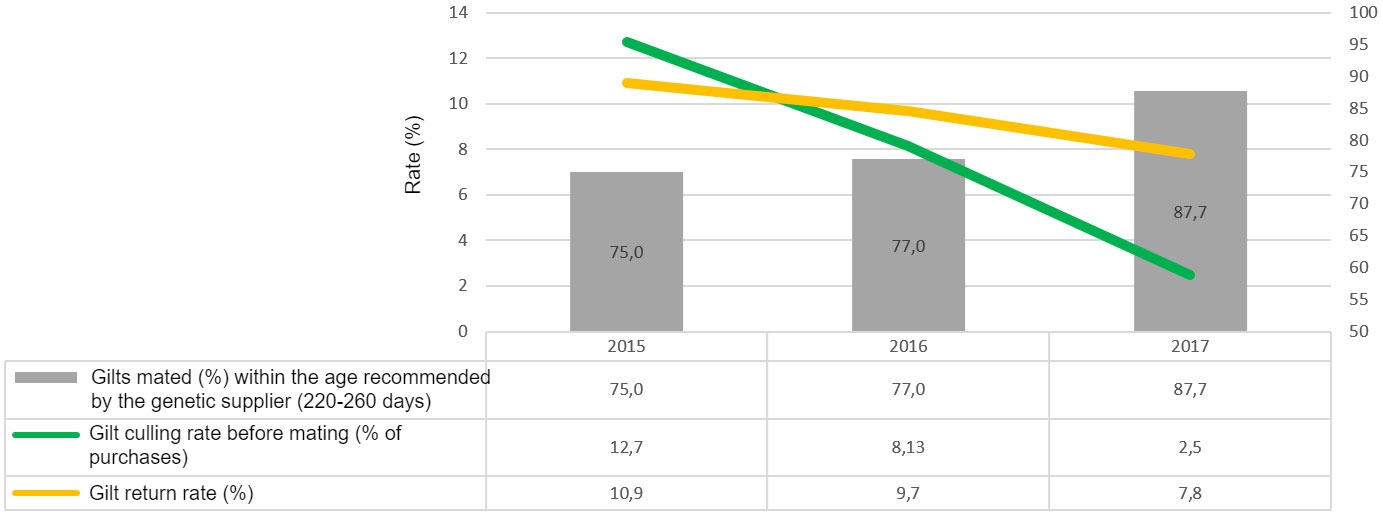
As a result of this greater attention to the gilts under acclimation, an improvement of the management indicators of these sows was observed (graph 2):
- Percentage of gilts mated within the age recommended by the genetic supplier (220-260 days).
- Gilt culling rate before mating (% of purchased animals). They were usually culled due to "no oestrus".
- Gilt return rate.
With the improvement on gilt management, the percentage of supersows in the farm and its possible influence on final production was evaluated. As shown in graph 3, the percentage of supersows almost doubled in 2 years and with it, the overall total born of the farm and weaned/sow/year, which increased by 3.4 points.
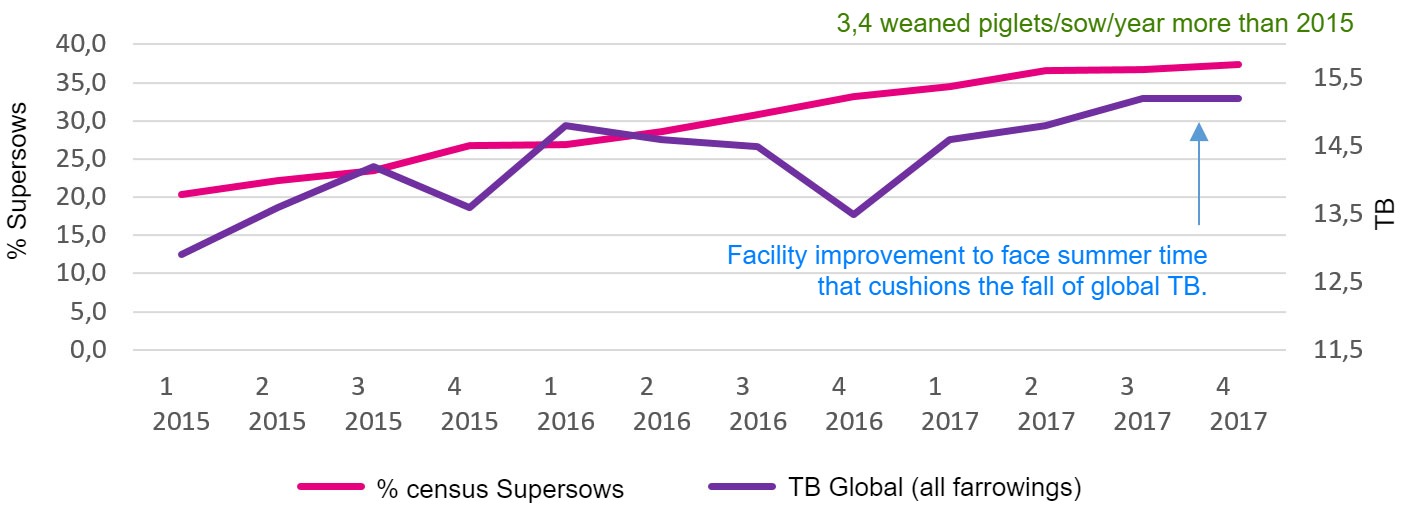
We can, therefore, conclude that the gilt management and control system designed to increase the number of supersows can be a tool to improve production at the farm, mainly in gestation, and reduce the costs incurred by pre-mating gilt culling.