
Feeding large groups of piglets: practical implementation of choice feeding
21-Nov-2016 (9 years 10 months 11 days ago)
Introduction
The most sensitive stage of pig feeding is post-weaning, especially the first two or three weeks.
This paper discusses choice feeding as an effective alternative in piglets feeding, given the current production conditions. Management and structural limitations present in many farms are considered, which condition the optimal development of piglets, development that cannot be addressed solely by changing nutritional levels in the feed.
Choice feeding is based on the ability of pigs to choose between two simultaneously available diets to meet their different growth needs over a period of time.
Practical implementation in field conditions
Conventional post-weaning feeding programs are based on changes in feed (from lacto-initiator to pre-starter, or from pre-starter to starter) based on a predetermined amounts of feed per animal, periods of time, or a combination of both (amount for lacto-initiator and periods of time for the pre-starter and the starter.) These times are usually customized to each pen in the batch of piglets: the amount or time the lacto-initiator and the pre-starter are supplied is reduced or increased depending on the size of the piglet. These changes often depend on the sensitivity of the operator in charge.
The change of diet should be applied over a reasonable period of time (2 or 3 days), but in many cases it is done in less than one day.
Sometimes control is a posteriori, based on the average consumption provided by management programs.
To establish the choice feeding system successfully, it needs to be adapted to each farm individually and to involve the operators in charge.
The key elements to the successful development of the system include:
- Clearly differentiating the dirty area from the clean area and, within the clean area, the feeding area from the lying area.
- Location of feeders and drinkers, and having a pen available specifically for problem piglets.
- Type of ventilation and heating.
Management Structure and Organization
- Duration of the lacto-initiator and pre-starter administration period must not be fixed, but left open.
- Train the operator in charge of the farm so that s/he can make informed decisions with regards to modifications of the length of this period based on age, quality and dispersion variability.
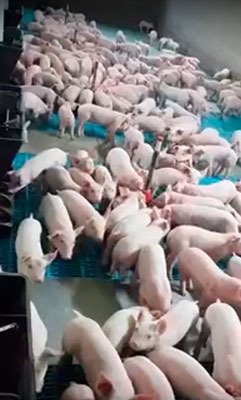 Sick, small or immature animals (segregated in the only pen in the open room) are included in the same feeding program, using the same previously outlined criteria, and join the rest of the piglets when their development status allows it.
- The lacto-initiator and pre-starter feeds are administered in different feeders, located alternately (so far proved to be the most suitable location in an open room), and in the best possible way to "help" define the dirty area and the clean area, depending on the conditions of each farm (Figure 2).
- Operators must be instructed to add the necessary amount of lacto-initiator to refill the feeding pans a minimum of three times a day avoiding, at all times, the presence of empty plates. Higher consumption in some feeding pans or hoppers is a common finding, and this may be due to social stimuli or, occasionally throughout the day, to one of the lying areas temporarily "blocking" the access.
- The time period in which both feeds are supplied simultaneously will vary depending on all the parameters described. Later on, all the feeding pans are removed and only the pre-starter is left in the hoppers, until completion of the designed program.
Results
Feed, pre-starter and lacto-initiator intakes were measured in the tests, comparing the conventional system to choice feeding. Choice feeding showed, in all cases, a lower intake of lacto-initiator and a higher intake of pre-starter.
Conventional programs were applied on farms A (2 batches) and C (3 batches), based on the administration of 1 kg of lacto-initiator followed by a pre-starter feed until 21 days post-weaning. On farms B (5 batches), D (3 batches) and E (3 batches) conventional programs were applied based on the administration of a lacto-initiator during the first week, followed by a pre-starter under the same conditions of the other two farms ( A and C).
Table 1. Lacto-initiator, pre-starter and total consumption per piglet at weaning in different farms with either a conventional feeding system or choice feeding. Source: Andres Donadeu, FEDNA specialization Course. 2013
| kg of lacto-initiator / piglet | kg of pre-starter / piglet | Total kg / piglet | ||||
| Farms | Conventional system | Choice feeding | Conventional system | Choice feeding | Conventional system | Choice feeding |
| A | 1.092 | 0.321 | 4.220 | 5.110 | 5.312 | 5.431 |
| B | 0.954 | 0.387 | 4.610 | 5.540 | 5.564 | 5.927 |
| C | 0.781 | 0.342 | 4.580 | 5.322 | 5.361 | 5.664 |
| D | 0.867 | 0.392 | 4.772 | 5.605 | 5.639 | 5.997 |
| E | 1.176 | 0.755 | 4.748 | 4.748 | 5.411 | 5.503 |
The increased consumption of lacto-initiator in conventional programs confirms that, unable to choose between two feeds, average consumptions soar in similar time periods, and suggests that it is due to the intake of the more developed piglets (more intake capacity). When allowed to choose, however, consumption decreases because the most developed piglets probably find the intake of pre-starter “more comforting”.
The higher intake of pre-starter feed in the choice feeding system versus the other same-length programs is due to the fact that they start eating it before, and therefore the period of exposure is longer.
We have seen a significantly better response to choice feeding in farms where the appearance of enteric problems (diarrhoea or soft stools) caused by excessive voracity during the first two weeks after weaning is very common. In such cases, in conventional management systems, the operator is often forced to either ration food in risk days, or to brusquely bring the administration of the following feed forward, in order to curb the incidence. Stress-free acclimatization between the two feeds, together with all the factors mentioned above, justify the performance differential obtained with respect to conventional programs in many farms.
Results indicate that the effect of space is crucial in improving performance (ADG) with choice feeding versus conventional systems (Table 2.)
Table 2. Space availability and average growth per piglet (ADG) in conventional feeding systems vs. choice feeding at post-weaning in different farms. Source: Andres Donadeu, FEDNA specialization Course. 2013
| Area (m2/piglet | Feeder (cm/piglet) | |||||||
| Farm | Program | Initial weight | Final weight | Δ weight | days | ADG (g) | ||
| A+B+C+D | Conventional | 5.854 | 18.763 | 12.909 | 40.725 | 0.317 | 0.195 | 4.72 |
| A+B+C+D | Choice feeding | 5.868 | 20.739 | 14.871 | 40.725 | 0.365 | 0.218 | 4.69 |
| Difference | 0.014 | 1.976 | 1.962 | 0.048 | 0.023 | −0.03 | ||
| Mean | 5.861 | 19.751 | 13.890 | 40.725 | 0.341 | 0.206 | 4.71 | |
| E | Conventional | 5.233 | 21.680 | 16.447 | 39.000 | 0.422 | 0.380 | 8.08 |
| E | Choice feeding | 5.173 | 22.193 | 17.020 | 39.000 | 0.436 | 0.407 | 8.03 |
| Difference | −0.060 | 0.513 | 0.573 | 0.015 | 0.028 | −0.06 | ||
| Mean | 5.203 | 21.937 | 16.733 | 39.000 | 0.429 | 0.394 | 8.05 | |
Another data that attracts attention is the appreciation of a greater uniformity in the batches of piglets at the end of this phase.
Conclusions
- The management technique of choice feeding applied, at least, at moments of diet change performed in conventional programs, is the best option for piglets of different weights and / or ages to choose between two feeds in order to meet their different growth needs.
- From a nutritional point of view, the feeds supplied in conventional management systems can be used in choice feeding systems, provided there is no excessive difference in palatability. In any case, new expectations open up in the design of formulations for choice feeding systems outside the periods of feed change.
- The implementation of choice feeding throughout the nursery cycle requires average minimum numbers of silos and feed distribution to facilitate handling.