
Risk factors of colibacillosis in the farrowing unit
04-Aug-2016 (10 years 2 months 16 days ago)
Colibacillosis in suckling piglets is one of the most common diseases, and the one that causes the most losses due to under-developed piglets and an increase in mortality.
It is a multifactorial process in which the causative agent is not the only one to bear great importance in relation to its clinical presentation; management factors and environmental conditions are often triggers or predisposing agents, not only to the clinical presentation of the disease, but also to its severity and course.
Risk Factors
1. Census structure in the farm: Imbalances in the census structure where the number of gilts is increased above 20% of the number of farrowings in the farm increase the risk, because the transfer of immunity in gilts is much lower than in multiparous sows.
2. Gestation feeding:
- Early gestation: (From service to 35-40 days of gestation.) High levels of consumption in the 3 days following service can increase hepatic clearance of progesterone (highly correlated with embryonic survival), but out of this time window, high levels of feeding have no impact on embryonic survival. Moreover, feeding at this stage has no correlation with diarrhoea associated with colibacillosis.
- Intermediate phase: The goal is to maintain body condition and to improve the still sub-optimal body condition of some sows. Special care must be taken, since overfeeding at this stage can lead to fatness of the mammary gland.
- Last third of gestation: There is some controversy regarding this stage: we think that an increase of intake is only indicated in cases where the sow's body condition is clearly insufficient. If we overfeed the sow, we exacerbate the effect of fattening of the mammary gland.
3. Environmental factors: Two different temperatures must be maintained:
- The room temperature should be kept between 22 and 24 °C, depending on the time of year. Draughts must be avoided, since they are triggers of diarrhoea.
- Plates temperature must be kept between 36 and 38 °C the first week after farrowing. Adding paper and an infrared bulb at farrowing reduces the incidence of diarrhoea.
4. Immunization: A vaccination program for gilts and sows against E. coli must be implemented. This program must be consistent with the infective pressure present in the farm and in accordance with the labelling indications.
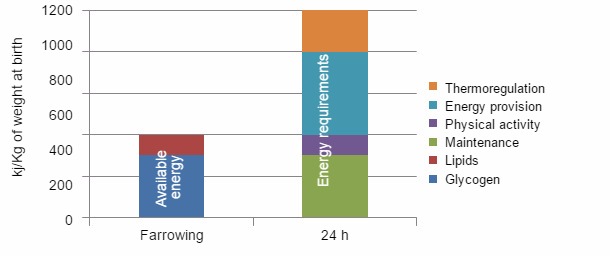
5. Colostrum intake: At present is very common that sows have more piglets farrowed than existing functional teats; therefore, a colostrum intake protocol needs to be implemented, not only to achieve an immune status but also to satisfy the piglets' needs of energy in the first moments after birth (Figure 1).
Figure 1: Energy availability at birth and energy requirements of a 24-hour old piglet.
6. Piglet movements protocol: Piglets should not be transferred within weeks or farrowing batches. Farrowing batches must be kept like watertight compartments. If there is the need for some transfers, we’d better move sows in order to generate foster mothers, but never transfer piglets. Therefore, and depending on the farm, the prolificacy levels and the number of under-developed piglets, gaps will be left in the farrowing room to introduce weaned sows as foster mothers.
7. Checking the sows' condition on their entry into the farrowing room: Sows with poor condition will likely be of risk to generate diarrhoeal problems in their piglets.
Table 2: Sows evaluation on their entry into the farrowing room.
| Healthy | Stressed | |
| Appetite | They eat all their food | They leave some food |
| Body condition | Optimal | Low, with weight loss |
| Response to stimuli | They stand up | They don't stand up, lethargic and apathetic |
| Weight distribution | Weight distributed on all four legs alike | Lameness |
| Skin | Short bristles and pink skin | Long bristles, yellow, pale or cyanotic skin |
| Gestation | Gestation maintained and good mammary gland development | Miscarriages and no development of the mammary gland |
| Body temperature | Empty: 38 ºC Pregnant: 40 ºC on the day before farrowing |
Empty: > 39 ºC Pregnant: > 40 ºC on the day before farrowing |
| Respiratory rate | Normal rate: 13-20/min | Dyspnoea, abnormal respiratory rate |
| Faeces | Normal consistency | Diarrhoea or constipation |
| Urine | Normal colour and density | Very white and pulsatile |
8. Cleaning and disinfection and depopulation protocols in maternity rooms:
- Mechanical cleaning of all organic matter, emptying and cleaning of the pit.
- Application of detergents with a low pressure spray to improve the effectiveness of scrubbing.
- Disinfection and disinsectization of the rooms, functional and cleaning testing of feeders and water troughs.
- Rooms must be completely dry before introducing the sows.
9. Staff training: Training protocols must be in place for every area on the farm. All persons joining the farm staff should go through a training process to provide them with the basic knowledge to develop their work.
| Risk conditions | Effect | Optimal conditions | Effect | ||
| Environment | Temperature of the room | • >22 ºC to <14 ºC | • ↓ feed intake and milk production • AImpairment of welfare |
• Thermoneutral zone for the sow (between 18 °C and 22 °C) without draughts | • ↑ lactation feed intake • ↑ milk |
| Temperature of the plate | • Cold | • Crushings | • Cool environment • Hot Plate • 36/38 °C • Extra light bulb • Fast drying |
• Resting on the plate • ↓ crushings |
|
| Sow's feeding | Water troughs for sows | • Flow rates < 2 L / min | • ↓ milk production • Water of high physicochemical and microbiological quality |
• > 2 L / min • Clean, fresh water • Bowl drinkers • Supplementation |
• ↑ lactation feed intake • ↑ milk |
| Sows' feeders | • Dirty • Remains • Fermentations |
• Cleaning • Accessibility |
|||
| Feeding curve | • Review gestation and lactation levels | • Possible mammary gland oedema | • ↓ colostrum and milk production in early lactation | • Care must be taken with feeding at mid and last-stage gestation | |
| Feed | • Types and intakes | ||||
| Depopulation, cleaning and disinfection | Depopulation, cleaning and disinfection | • Depopulation < 3 days • Humidity • Absence of cleaning • Absence of disinfection |
• ↑ pressure of infection |
• Drying |
• ↓ pressure of infection |
10. Water quality: Water is the most important nutrient, and its microbiological and chemical quality is essential to prevent physical problems in the farrowing unit. Water needs to be treated appropriately and supplied in the amounts required for each stage of production.