
Risk factors associated to Oedema disease in pigs
11-Mar-2016 (10 years 6 months 28 days ago)
The big picture
The importance of enteric infections in pigs has increased dramatically in the recent years, mostly during the weaning and transition phases in the production unit. This fact has induced a negative impact in the pig production overall.
Oedema (or just “edema”!) disease (OD), “bowel oedema” or “gut oedema” is a lethal disease affecting pig production worldwide. This is one of the syndromes induced by the ubiquitous bacterium Escherichia coli (E. coli) in pigs. In this case, OD is caused by toxins produced in the small intestine of pigs by certain pathogenic groups of this pathogen. The typical syndromes induced by E. coli in pigs are summarised in Table 1. Historically, they have been classified depending on the age of the animals and the production phase. However, we have been observing that the onset of the clinical manifestation of E. coli infections have been changing in the last ten years, with less cases of neonatal colibacillosis and more cases in transition periods.
Table 1. Clinical syndromes due to E. coli infection and most commonly affected age periods
(adapted from Fairbrother and Gyles, 2012)
| Syndrome/Age period | Newborn | Suckling | Postweaned | Grower-finisher | Adult |
| Neonatal diarrhoea (watery diarrhoea, dehydration, high mortality) | |||||
| Septicemia (polyserositis, polyarthritis, depression, shock) | |||||
| Young pig diarrhoea (moderate diarrhoea, growth retardation, low moratality) | |||||
| Postweaning diarrhoea (moderate to severe diarrhoea, mortality around 25% if untreated) | |||||
| Oedema disease (sudden death, variable clinical signs, oedema) | |||||
| Urogenital infection (cystitis, pyelonephritis) |
OD in a nutshell
OD occurs typically in transition periods, normally during the first 2 weeks after weaning. However, OD is increasingly being observed during the transition from nursery to fattening. The disease can be observed as a sporadic case in a farm or affecting the entire herd, causing typically high mortality rates in affected animals. Sudden deaths without any clinical typical sign are frequently observed and post mortem examinations can help us to identify the typical lesions that give the name to the disease: the presence of a gelatinous oedema in the gastric submucosa, the mesocolon (Fig. 1), the small intestine mesentery and the gall bladder.
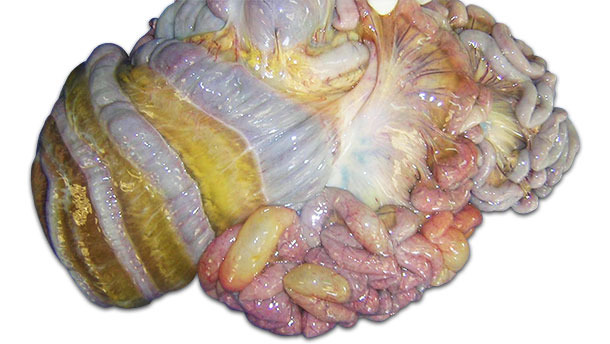
Fig. 1. Oedema in the mesocolon and mesenterium (Prof. L. Carrasco. University of Córdoba).
Risk factors and how to control OD
The most important risk factor associated to OD is the lack or scarce presence of specific local protective immunity in the small intestines of piglets. The piglets get the typical secretory immunoglobulins (IgA) that prevents E. coli adhering to the small intestine mucosa from the mother’s milk. After weaning, the presence of IgA from the mother’s milk in the piglet gut disappears and then becomes highly susceptible to this disease. For those reasons, OD will normally appear after 1 or 2 weeks post-weaning and most likely associated to the presence of other risk factors as:
- Stress. A word always present in any risk analysis in animal production. However, due to the pathogenesis of this infection, there are some steps during production nowadays that may be crucial enhancing the stress levels in the piglets, e.g. the weaning from the sow, ranking fights within the group or transportation even minimal distances to change housing.
- Genetic predisposition. Certain breeds have been historically associated to higher incidence of OD. We know that pigs from different genetic backgrounds express different cell receptors associated to the recognition and adherence of specific fimbriae of E. coli. This can be one cause associated to the highly variability in the morbidity of OD in different production scenarios.
- Nutritional factors. Special attention must be taken to percentage of protein in the diet. Piglets can only digest up to 45% of crude protein (value expressed in terms of dry matter). Depending on the production system, the percentage of low digestibility protein in the diet is variable. The higher percentage of low digestibility protein, the higher the risk of gastrointestinal problems. Highly digestible proteins (from milk, plasma protein, fish or egg) are very valuable in the first stages post weaning. Vegetable protein, sometimes obtained as a by-product, may have a variable percentage of digestibility, and this has to be taken into account. The restriction of feed intake and the decrease of the protein content in the ration has been a typical measure to control OD basically reducing the quantity of low digestibility proteins. An imbalanced content of sugars and fats may also have an effect in the normal intestinal pH and flora inducing the growth of pathogenic bacteria, including E. coli.
- Normal gut flora. The difference between piglets of different ages at intestinal level in terms of microbial flora is huge. The animals at weaning will undergo a massive change from liquid to solid diet. Changes in the environment may also induce changes in the intestinal flora easing the proliferation of E.coli. Some studies have reported the beneficial use of prebiotics and probiotics to control OD and colibacillosis in general, although there are some reports with controversial results.
- The use of Zinc oxide. The addition of Zinc oxide (at 2500 to 3000 ppm) to the ration has been an extensively used alternative to antimicrobials to control colibacillosis. This measure, if maintained beyond 2 weeks after weaning may have an important effect on the intestinal flora, especially negative against Lactobacillus spp. The abrupt withdrawal of the Zinc Oxide supplementation favours the growth of E. coli in the small intestine and the appearance of enterocolitis or OD.