
Milk replacements
17-Nov-2015 (10 years 10 months 22 days ago)
The increase of prolificacy in recent years has led to the number of piglets in a litter even exceeding the number of teats per sow, leaving us with extra piglets already on farrowing day. This forces us to choose a 10% of nurse sows a week, or to supplement with milk replacers, or both. This article will focus on the use of milk replacers.
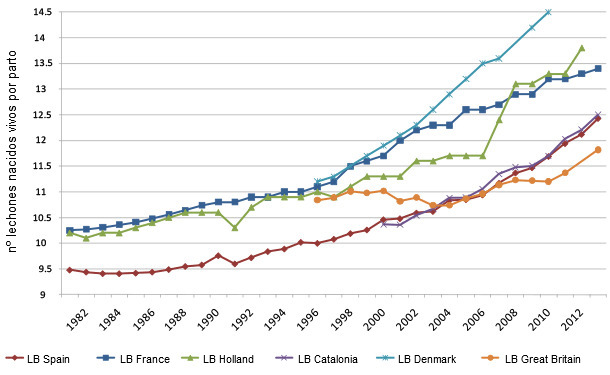
Graph 1. Evolution of the number of piglets born per litter in different countries.
Source: Observatori del porcí (DAAM) 2013. Grup Gestió Porcina, UdL.
Using milk replacers
Benefits
- Using milk replacers helps to increase the piglets weight at weaning.
- It reduces preweaning mortality.
- It reduces handling and the need for extra space for the nurse sows.
- It improves adaptation to solid food.
- It generates greater uniformity in the litter.
- By minimizing the movement of piglets, it reduces the risk of spreading disease.
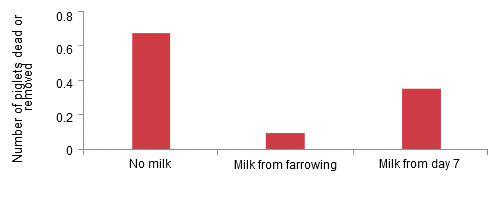
Graph 2. Effect of milk supplementation on piglets deaths. Stewart (2009)
Disadvantages
- It could mask management, nutritional and health problems that affect maternal milk production, reducing its performance.
- Extra space is needed at weaning.
- Incorrect use increases costs because it is a high quality and expensive product.
Different systems
These milk replacers can be given both to suckling piglets that are still with ther mothers, as a supplement, and to early weaned piglets.
In either case, the milk replacers can be administered manually or through an automatic system. In the two automatic systems shown below access to milk is ad libitum.
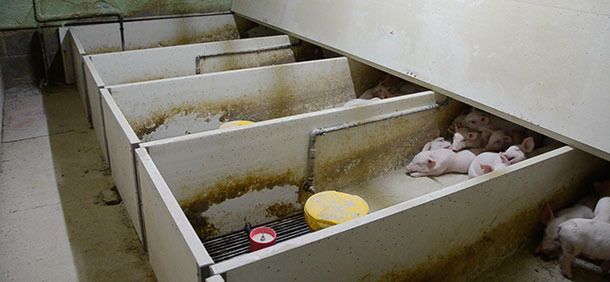
Photo 1 Automatic continuous milk dispensing with a closed loop system.
(Courtesy of Eduard Cau)
When there is a lack of space, a variation of this system consists of setting up some nesting boxes or "incubators" above the farrowing crate.
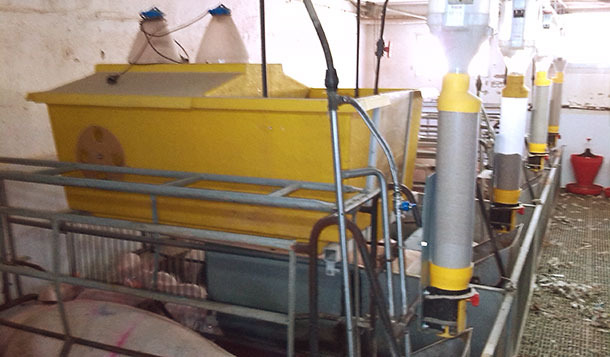
Photo 2 Automatic continuous milk dispensing with nesting boxes in the farrowing room.
(Courtesy of J. Wennberg)
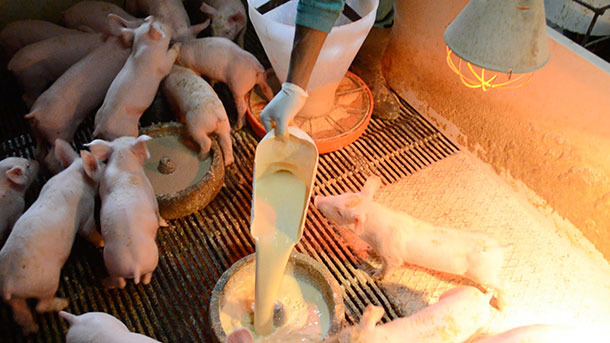
Photo 3 Manual milk dispensing in feeding pans in nursery.
(Courtesy of Lluís Porcar)
Early weaning
Supplementing the litter with a milk replacer in the farrowing room is gradually being put in place in some countries, looking for a weight gain at weaning and litter uniformity. A milk replacer is often used from the first day of life in lighter litters.
We have mainly used it in early weaning. To that end, we can feed the piglets in a small room or an adapted room.
1- The recommended manual pattern would include the following steps:
- Wean 7-to-9-day-old piglets with good body condition.
- Days 0 to 5: prepare milk following the manufacturer instructions 2 or 3 times a day (two pints of milk per litter, approximately), and supplement with gruel made with prestarter feed 2 or 3 times a day.
- Days 6 to 10: reduce the number of times the piglets feed on milk only, maximize the gruel, and gradually introduce the prestarter in dry form.
- Days 11 to 15: feed less gruel and provide dry feed.
- Water must always be supplied in an ad libitum basis.
- If there's some feed left from one administration to the next, remove it.
2- Automatic systems: 7-to-9-day-old piglets are transferred to a room where they'll feed on milk until they reach a LV of 5 kg approximately, or an age of 15-18 days. In this case, water and a prestarter must be supplied as well.
Proper sanitization of the circuit is very important in such systems. We recommend a weekly cleaning consisting of filling the whole circuit with hot water at 55-60 °C for 20 minutes, followed by another 20 minutes with water plus an alkaline agent, and a subsequent rinsing.
Comfort is important
Good control of air temperature in the room is crucial for early weaned piglets; ideal conditions will include an air temperature of 30 °C plus a hot spot if necessary, an environment as dry as possible (we recommend the use of paper bedding or dusting powder), and it is especially important to avoid drafts. Structures like nests, for example, often work well.
Conclusions
We must be very knowledgeable about our sows’ genetics and their milk-producing ability, to ensure that we are maximizing their potential and not incurring an overuse of milk supplements, thus increasing production costs. It is advisable to answer some important questions, like: Is there a good feeding curve?; Is the sows’ body condition optimal?; Is the water flow adequate during lactation?; Are all the teats being sucked? etc.
That said, the use of milk replacers is helpful in hyperprolific breeds with over 14 LB per sow, both to increase the number of weaned piglets and to simplify the management of nurse sows.
We believe that this type of management will be consolidated in our farms, as producers will have to solve the challenge of hyper-prolificacy in the current breeds.