
Creep feeding and lactation length
20-Jul-2015 (11 years 2 months 23 days ago)
Multiple factors contribute to a good start for piglets after weaning: age, health, environmental temperature, management, all-in/all-out systems, density, etc. Other than that, all the good practices that can also help minimize the stress of change musn't be neglected. Thus, throughout this article, we will focus our attention on one of them: creep feeding.
The practice of creep feeding, or supplementing the piglets' milk diet with creep feed in the farrowing room, is widespread today. However, there are still some doubts about its benefits depending on the age at weaning, or what kind of feed we use and for how long.
In this article, we will try to answer some of these questions.
There are two important reasons to supplement piglets with feed in the farrowing room:
- Piglets are born with low levels of amylase and high levels of lactase. This initial enzyme profile is ideal for digesting milk protein, but not for the vegetable and/or animal protein found in weaning feeds. Feed supplementation in the farrowing room allows for an early change of this enzyme profile.
- Sows milk and post-weaning fasting (photo 1) both have a negative effect on the length of the intestinal villi. The sooner the piglet starts a solid diet, the less subsequent diarrhoea and adaptation issues it will develop.

Picture 1: Anorexia in weaned piglets
When is the right time to start creep feeding?
Some producers might have doubts about the need for this practice when lactation periods are short (21 days or less), or about how long it needs to be implemented.
Granted, creep feeding probably doesn't make much sense in the first two weeks of lactation, but from then on, the percentage of piglets that ingest feed increases. (Figure 1: Courtesy of Jordi Ventura)
| Week | Creep feeding |
| 8 | 80% |
| 7 | 65% |
| 6 | 50% |
| 5 | 35% |
| 4 | 15% |
| 3 | <5% |
| 2 | ≈0% |
If the lactation period is longer than three weeks, it is advisable to lengthen creep feeding to 10-15 days. Some studies have concluded that the number of animals that ingest feed increases by 10% when creep feeding is implemented for 13 days, compared to only 2-5 days.
Therefore, we recommend to start creep feeding at 15 days of age, regardless of the duration of lactation.
Keys to success for creep feeding
If we decide to offer piglets feed in the farrowing room with maximum efficiency, it is advisable to follow some best practices that we believe to be useful:
-
Since intake is low, we must use feeds with aromas and flavours that appeal to the largest possible number of piglets. Not every feed is effective.
-
It should also include highly digestible protein.
-
It is better to use powdered feed, as it sticks to the snout and forces piglets to lick it.
-
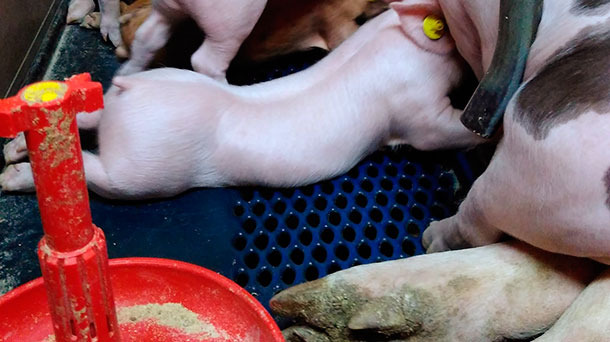
Supplement from 10-15 days of age, in small quantities (200 gr per litter), and several times throughout the day, away from heat sources, corners, troughs and the sow.
-
The use of feeding pans ensures feed quality is maintained, and it also reduces feed waste.
-
Remove the feed that has not been eaten but has an unhealthy appearance. Or try a more palatable feed.
-
The sow eats and lies down to feed its piglets. It is better not to provide creep feed at that time, but between the sow's feeding periods. (Picture 2)
-
Keep the feed in a closed container in a dry place, thus avoiding the loss of aroma and preventing it from becoming rancid.
-
It is advisable to maintain access to the same creep feed after weaning, in order to smooth the transition to subsequent feeds, making it gradual and less traumatic. A good way of doing this would be to put the creep feed in the feeding pans, and to pour the subsequent feed in the hopper.
It should be noted that creep feed is no substitute for sow's milk, and we must make the most of the sow's milk potential. The effect on litter weight or the benefit on the sow's loss of body condition is usually negligible or non-existent, respectively.
Ultimately, the objective of supplementing piglets with creep feeds is to reduce the number of under-developed animals during the first days after weaning and, albeit with some differences, it is beneficial for both 21-day and 28-day lactations.