
Withdrawal of medication in feed: impact and most affected piglets
24-Aug-2015 (11 years 1 months 25 days ago)
Since the ban on the use of antibiotics as growth promoters by the European Union on January 1, 2006 (EC 1881/2003), the pork industry has been looking for alternatives to offset the fall in production after weaning. Most producers have found refuge in the ZnO to avoid this fall in production and nursery pig mortality.
However, diets with high levels of zinc (2,000 mg / kg ZnO) administered for more than 10 days cause high concentrations of Zn in the manure. Accumulation in the topsoil (0-20 cm) can promote changes in the ecosystem when manure is used as a soil amendment. Moreover, recent studies warn about the possible development of antimicrobial resistance (ampicillin and tetracycline) associated with the use of high doses of Zn (Hölzel et al, 2012;. Bednorz et al, 2013.)
For now, the EU recommends not to exceed 2.5 kg Zn / tonne of feed when ZnO is used therapeutically for the first 14 days post-weaning, and always under veterinary prescription. But trends suggest that within a few years the EU might further restrict its use or even ban it, and there are already some EU countries, such as Holland and France, where its use is prohibited.
This makes pork producers wonder about the effects and costs of the ban/reduction of ZnO in post-weaning diets and about possible nutritional strategies.
To this aim, we conducted a study to evaluate a possible strategy in the face of a hypothetical ban on ZnO and its effects on performance and mortality in the weaning period. So, we compared:
- The current strategy, Medicated (M) Diet, with ZnO, Ab and high levels of protein (2,480 ppm of Zn as ZnO, colistin 120 ppm, amoxicillin 300 ppm, NE 2,627 Mcal/kg, CP 20,2%, total Lys 1,37%.)
- A future strategy, NON-medicated Diet (Ø), without ZnO or Ab, and low levels of proteins (compliant with the ideal amino acid profile), reducing the buffering capacity (reduced calcium carbonate) during the first 14 days post-weaning, and including highly digestible ingredients, which are palatable and with a low buffering capacity (such as animal serum and plasma), (NE 2,531 Mcal/kg, CP 16.5% and Lys 1.20%.)
Why did we decide to implement these measures on the NON-medicated diet?
- Reduced protein: An excess of non-digestible protein in the diet promotes microbial fermentation and increases the production of potentially toxic substances that are also predisposing factors for diarrhoea (such as phenols and ammonia.) Simultaneously, decreasing the amount of protein also helps reduce proliferation of E. coli and its binding to the intestinal mucosa (Opapeju et al., 2015). Whilst applying this strategy, however, we must make sure the potential growth of the pig is not affected. Likewise, we must also bear in mind that maintaining the ideal AA profile (beyond the commonly controlled 5-7 AA) becomes more relevant when reducing the protein content.
What sources of highly digestible protein can we use?
- Dairy products (caseinates, skimmed milk, whey), which also help acidify the piglet's GI tract.
- Animal protein concentrates such as egg protein and porcine plasma are already very high quality proteins with a suitable amino acid profile, and they also provide immunoglobulins that are active against diarrhoea-causing pathogens.
- Facilitating acidification of the gastrointestinal tract: Gastric acid secretory capacity in piglets is poor, and mainly due to the bacterial fermentation of milk lactose. After weaning, piglets start consuming solid feed with ingredients of vegetable and mineral origin (high buffering capacity, i.e. the ability to neutralize acids) that increase gastric pH, hence decreasing digestion, increasing the survival of pathogens and promoting the occurrence of diarrhoea. To make matters worse, ZnO and calcium carbonate, which are ingredients with a high buffering capacity, are added to the feed (Lawlor et al., 2005.)
The study was conducted in a commercial farm, with a total of 400 animals. Feed intake was recorded during the weaning period (0-35 days), and all animals were weighed individually at day 0 (weaning), and at 14 and 35 days post-weaning. Mortality was also recorded by phase —pre-starter (0 to 14 d) and starter (14 to 25 d)— and in the full weaning period. Upon entry into the fattening phase (35 d post-weaning), the same commercial diet was offered to all the animals, and they were weighed every 3 weeks until slaughter.
No differences were found in weight, weight gain or delay in reaching slaughter weight (105 kg) between the two strategies (Figure 1). However, it was noticed that the animals that had received the non-medicated diet (Ø) ate more than the ones on the medicated diet (M) ,and thus obtained a worse feed conversion rate during the nursery phase(Table 1).
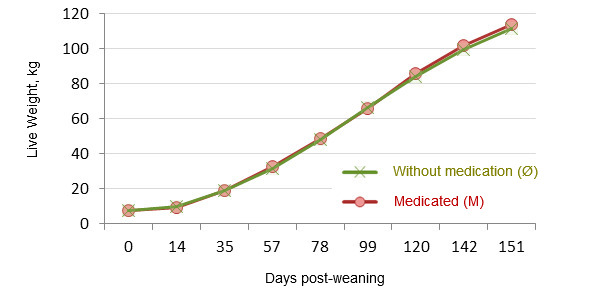 Figure 1. Evolution of live weight from weaning (day 0) to slaughter (day 151).
Table 1. Productivity performance (LW: live weight, ADG: average daily gain, ADC: average daily consumption and FCR: feed conversion rate) during the weaning period (0-35 days post-weaning).
| Strategy | Standard Error | P-value | ||
| Without medication (Ø) | With medication (M) | |||
| LW0, kg | 7.1 | 7.2 | 0.16 | 0.753 |
| LW14, kg | 9.4 | 9.0 | 0.22 | 0.161 |
| LW35, kg | 18.6 | 18.5 | 0.49 | 0.818 |
| ADG 0-35 g/d | 318.9 | 322.4 | 11.03 | 0.800 |
| ADG 0-35 g/d | 535.1 | 447.0 | 14.04 | <.0001 |
| FCR 0-35 | 1.690 | 1.379 | 0.03 | <.0001 |
The greatest difference was observed in mortality, especially in the pre-starter phase, where the difference between non-medicated and medicated animals was 7 points (12% vs. 5%, respectively). Mortality to 14 days was classified according to the initial weaning weight percentiles to find out which group of pigs was more affected. Figure 2 shows that most of the animals that die are small, and most of them on the non-medicated diet. After 14 days there was no difference in mortality.
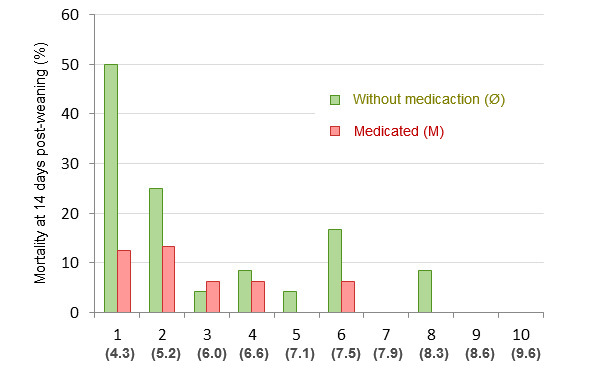
Figure 2. Mortality at 14 days post-weaning distributed per percentiles.
The number in parentheses is the average initial live weight (kg).
We can conclude that the animals most at risk are those with a lower weight (and probably younger); even if they are offered a diet low in protein, with a low buffering capacity and highly digestible and palatable ingredients, this is not enough to prevent post-weaning diarrhoea and its consequences, possibly because these animals do not eat as much as they should, thus not meeting their needs. Therefore, we can anticipate that the full withdrawal of drugs will lead to an increase in mortality and a decrease in production rates, which will force us to refine management (for example, treating the smallest animals separately) and continue to seek new strategies to meet the current standard production levels.