
Clinical case: I'm getting abnormal piglets
06-Jul-2015 (11 years 3 months 5 days ago)
Background
This is a multiplier farm with 800 sows in a farrow-to-finish cycle. Sites 2 and 3 are separated from site 1, but within the same farm. The animals are given a liquid diet. The farm is PRRS positive, but stable (unevenly). Transition and fattening are modular.
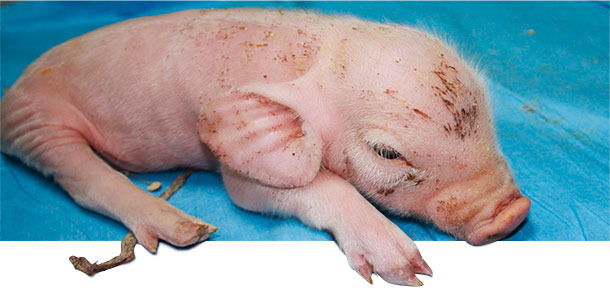
The farmer comes to us saying his piglets are born «abnormal» or dead, or else they die within the first days after farrowing. Especially piglets born to gilts. It has become worse after a bout of PRRS. The number of affected piglets per litter is 20 to 30%.
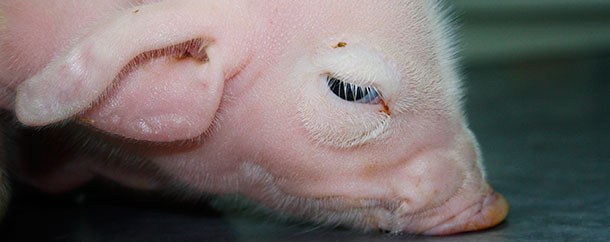
The first thing we ask ourselves is what getting «abnormal» piglets means, and after checking these piglets "in situ", we can see that they present a phenotype problem or, at least, this is what we can see at first sight (Figure 1 and 2).
Research phase
Some animals were sent to the Department of Pathology of the Faculty of Veterinary Medicine of Zaragoza, for a study.
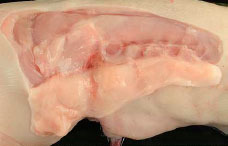
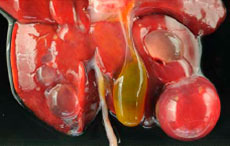
The first animals we sent had a subcutaneous oedema and serous cysts in the liver (Figures 3 and 4).
|
Figure 3. Subcutaneous oedema |
Figure 4. Serous cysts in the liver |
Gross lesions
- Moderately distended stomach, intestines filled with gas without visible changes in the mucosa. The other organs did not present significant changes.
Microscopic lesions
- Liver: Significant loss of hepatocytes diffusely distributed within the lobules, moderate hepatocyte disorganization and discrete diffuse hepatocyte ballooning degeneration.
- Heart: Discrete multifocal bleeding in the endocardium and discrete mononuclear inflammatory infiltrate in the coronary arteries. Myocarditis and myocardial cell necrosis.
- Intestines: Dilation of the lymphatic vessels of the villi, mononuclear infiltrate in villi and submucosa.
- Brain: Perivascular cuffing
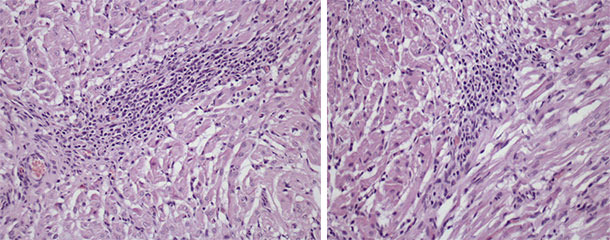
| Myocarditis in Piglet 1 | Myocarditis in Piglet 2 |
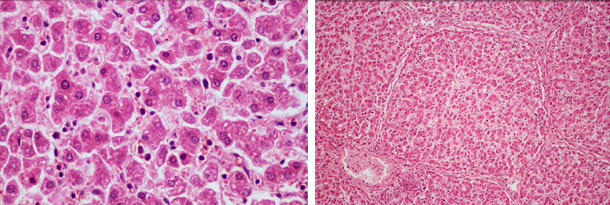
| Diffuse hepatocyte ballooning degeneration. | Diffuse hepatocyte disorganization. |
Pathological diagnosis:
- Degeneration, disappearance and diffuse disorganization of hepatocytes, and myocarditis.
Based on these findings, the decision is made to carry out biochemical analyses with the affected and the apparently normal piglets within the litters.
| Abnormal Piglet 1 | Abnormal Piglet 2 | Abnormal Piglet 3 | Abnormal Piglet 4 | Normal Piglet 1 | Normal Piglet 2 | Normal Piglet 3 | |
| ALB | 0 | 0 | 0 | 0.4 | 2.5 | 1.3 | 2.5 |
| ALT | 60 | 47 | 56 | 60 | 63 | 27 | 28 |
| BIL | 0.4 | 0.4 | 0.4 | 0.5 | 0.4 | 0.5 | 0.9 |
| BUN | 8 | 11 | 12 | 7 | 7 | 4 | 9 |
| CRE | 1.3 | 1.2 | 0.6 | 0.5 | 0.5 | 1 | 0.7 |
| TP | 3.2 | 4.4 | 4 | 4.5 | 6 | 4.9 | 5.3 |
| GLOB | 0 | 0 | 0 | 0 | 3.5 | 3.6 | 2.8 |
ALB (albumin), ALT (Alanintransferasa), BIL (bilirubin), BUN (Urea), CRE (creatinine), TP (total protein), GLOB (globulin).
A fast analysis showed that both albumin and globulins levels were 0 or nearly 0, so a protein profile of these animals was performed and it was found that the values were not zero but were deffinitely too low.
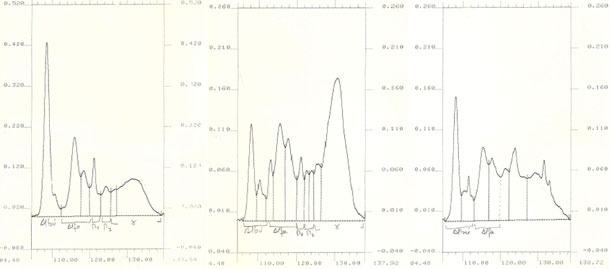
| Abnormal Piglet 1 | Abnormal Piglet 2 | Abnormal Piglet 3 |
Differential diagnosis
- In 2004, in the Australian Veterinary Journal, a group of researchers led by Dr. Steven McOrist defined a syndrome that affects newborn piglets causing the following symptoms:
- Stillbirths or birth of small piglets
- Subcutaneous oedema in head and chest.
- Some piglets present a subcutaneous oedema throughout their bodies, reason why they are known as "Jelly piglets".
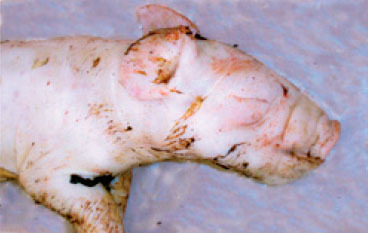
Picture courtesy of Dr. Steven McOrist
- In 2007 P.D. Kirkland et al. isolated the virus that causes porcine myocarditis syndrome (PMC) in pigs. It is a Pestivirus that belongs to the family Flaviviridae.
- It causes the following lesions:
- Non-suppurative multifocal myocarditis, with myonecrosis in some cases.
- Secondary congestive heart failure.
- Subcutaneous oedema in the skull and transudate in the thoracic cavity.
- There is NO liver damage
It is called myocarditis syndrome in the piglet, and it is caused by the Bungowannah virus.
Given that the Bungowannah virus is also a pestivirus (like the BVD virus) and in most cases in pigs there is a cross-antibody response between different species of pestiviruses, and given that the Bungowannah virus is suspected, an analysis of BVD is requested for these piglets; the results were negative.
We must remember that our "abnormal" piglets had very low values of albumin and globulins, whereas their ALT levels were more than double those of "normal" piglets. Albumin accounts for between 35 and 50% of total serum proteins. It is synthesized in the liver.
We delved into the issue of the hipoalbuminemia. This alteration may be due to:
- Nephritis, nephrosis and glomerular disease (elevated BUN and CRE).
- Starvation, malnutrition, chronic gastrointestinal diseases.
- Liver disease, liver necrosis, hepatitis (elevated ALT and ALP.)
- Alcoholism.
In the view of all this, we should remember that the farm under study uses a liquid feed.
One of the protein sources in this feed is beer yeast.
This yeast had an alcohol content of 2,6º, and each animal was given 2 litres of yeast per day during gestation.
And this is when we ask: Can alcohol have an effect on a sow's gestation?
In human medicine there is a syndrome called "foetal alcohol syndrome" (FAS).
- Syndrome diagnosed in the US in 1973
- Caused by alcohol consumption by the mother during pregnancy.
- It causes the following changes in the newborn:
- Poor foetal growth phase.
- Decreased muscle tone and incoordination.
- Delayed mental development.
- Cardiac abnormalities.
- Changes in the structure of head and face.
Corrective measures
Faced with the fact that the animals showing symptoms are mainly produced by gilts, we suspect that, having never before been given a liquid feed —and therefore yeast (alcohol)—, this type of diet could have a greater effect on this group of animals. Multiparous sows, who also receive this type of feed during farrowing and in subsequent pregnancies, could have a "habituation" factor, and therefore a better tolerance of these rates of alcohol.
Yeast was eliminated from these animals' diet for a period of 6 months, and the appearance of "abnormal" piglets stopped.
Conclusions
Based on all points assessed, we dare to describe a new syndrome in pigs:
Porcine Foetal Alcohol Syndrome
- Etiology: Intake of the toxic ethyl alcohol.
- Pathogenesis: It affects mainly pregnant gilts which diet includes yeast or other components with a large alcohol content.
- Clinical signs: Piglets born with external and internal birth defects, especially in the liver and heart.
- Biochemistry: Hypoalbuminemia, increased ALT.
- Gross findings: Subcutaneous oedema and altered phenotype.
- Microscopical findings:
- Liver: Significant loss of hepatocytes diffusely distributed within the lobules, moderate hepatocyte disorganization and discrete diffuse hepatocyte ballooning degeneration.
- Heart: Discrete multifocal bleeding in the endocardium and discrete mononuclear inflammatory infiltrate in the coronary arteries. Myocarditis, myocardial cell necrosis.
- Differential diagnosis:
- Parental cosanguinity.
- Avitaminosis B.
- Protein-losing enteropathy (PPE).
- Porcine myocarditis (PMC) syndrome.
- Kidney failure with glomerular disease.
- Predisposing factor: Ethyl alcohol intake during gestation, mainly in the last month, gilts being more sensitive than sows.
- Diagnosis: Piglets with subcutaneous oedema and liver and heart lesions. Biochemistry: hypoalbuminemia.
- Treatment:
- Removal of toxic causing the problem.
- Vitamin B12 supplements.
- Liver protectors.
- Increasing methionine in the ration.