
Heat Stress Management Strategies on Farm
03-Aug-2015 (11 years 2 months 13 days ago)
Heat stress is a very important factor to consider in the pig production cycle, because pigs have fewer mechanisms against heat than other species. The ancestors of pigs, wild boars, have evolved in a lush environment covered with luxuriant vegetation and, therefore, little exposed to the sun. Therefore, the systems developed by the species to lose heat are mainly behavioural: i) looking for shady and cool areas where they can lie down on their side in order to increase their body contact area with the ground; ii) moistening their bodies with water or mud when temperatures rise in order to lose heat by evaporation; and iii) panting, as a last resort, in order to evaporate hot water straight from the mouth and consequently cool down. Given that they have not evolved in open and very exposed areas, they have not had the need to develop sweating, making pigs a particularly sensitive to heat stress species.
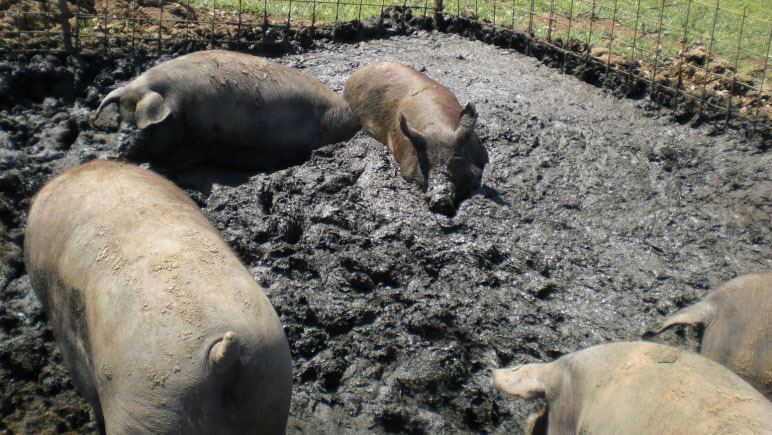
Figure 1. Iberian pig creating its own wet area to lie down in an outdoor plot.
Therefore, in order for the animal to be able to thermoregulate in the best possible way, we must combine different strategies:
-
Obviously, a ventilation system will always help. A light breeze can lower their apparent body temperature by a couple of degrees, as it replaces the hot air around the animal with cooler air.
-
Pen space is also critical; an 80-kg pig in a lateral recumbent position occupies an area of about one square meter, whereas the space occupied while standing or on sternal recumbency is less than half a square meter. This means that, under conditions of heat stress, the animals require more space just to lie down and lose temperature. In other words, the 0.60 m2 required by law for an 80-kg animal can work perfectly in winter, but cause serious problems of competition for space in summer.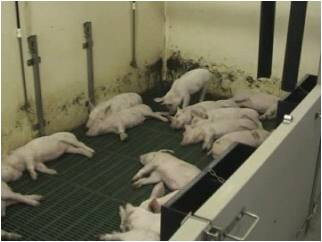
Figure 2. Animals lying down due to high environmental temperatures.
- Providing a cool, moist floor may help. I.e., in hot conditions we will avoid warm floors, especially straw, not only to avoid microbiological growth, but because straw increases apparent temperature by 3-4 degrees. If the floor does not provide a cool, wet area, the animals will look for it in the dunging area, moving the rest area to this area in order to keep their bodies wet and lose heat by evaporation, resulting in very dirty animals, a good indicator of heat stress problems in the pen.
- It is important to note that relative humidity must be low in order to favour heat loss by evaporation. The rule to lose heat is simple: dry environment and wet animals. An environment saturated with water, which cannot accept any more and therefore allows no evaporation, is the worst thing that can happen to an animal suffering from heat stress.
- If the farm walls are exposed to direct solar irradiation in the afternoon, we will isolate the inner side of the walls so that the sun does not heat the room when then animals should start noticing the environment cooling down and have their second meal of the day. In fact, the animals will tend to separate inactivity and feeding periods more clearly than in lower temperatures, so that meals will be concentrated mainly in the first and last hours of the day, with much less activity in the central hours.
- Providing a good feeders / animals ratio in the pen is essential to ensure that animals, or at least some of them, the subordinates, do not eat other than in the cooler hours. Eating when it's hot means they will be eating less, and a greater dispersion of weights will be noticed between dominants and subordinates. Improper distribution of feeding and drinking areas, and activity and rest areas, may increase competition for food, which will be aggravated in heat stress conditions, when feeding times are concentrated in less hours.
- Finally, another strategy to consider is based on feed formulation. If formulas less hard on the digestive system (producing less heat) are given, the animal will ingest more of the dietary energy and the reduction in consumption due to heat will be less noticeable. Part of this reduction is due to the animal's lack of will to produce heat by digesting its food, so a digestion that generates less heat will ensure a higher food intake. For example, since fat provides direct energy with little loss due to digestion processes, including more fats in their diet increases energy levels and reduces heat production during digestion.
- Cooling the drinking water and providing a liquid diet —or combining liquid and solid— can also help.