
Porcine Epidemic Diarrhea in US – Field update
23-Jun-2015 (11 years 3 months 20 days ago)
Porcine epidemic diarrhea virus (PEDv) was confirmed to be in the U.S. on May 16, 2013. This disease had never before been diagnosed in the U.S. Because this was a new disease, state diagnostic laboratories did not have any assays specific for PEDv and thus no monitoring for the virus had been done previously. Testing of banked serum from previous case submissions identified a finishing herd in Ohio as the first known case sometime around mid-April, 2013. In just 2 years, a lot has happened and a lot of farms have been infected. One of the questions is, how much has disease changed from its first introduction?
Background
From April 29 to May 7, 2013, the Iowa State University Veterinary Diagnostic laboratory (ISU-VDL) had received 4 different case submissions from sow farms experiencing explosive diarrhea and some vomiting in sows and piglets. No sows died, but the mortality in affected nursing piglets approached 100%. This clinical presentation was “classical” transmissible gastroenteritis (TGE). Transmissible gastroenteritis has been around in the U.S. for decades, but over the past 10 years, its clinical incidence in sow farms was rare. As the first 4 independent submissions were made, the ISU-VDL TGE diagnostics were being reported as negative. This was a perplexing and challenging outcome. Field veterinarians were questioning the accuracy of the TGE assays while ISU-VDL diagnosticians were digging deeper into their toolbox to better figure out what was going on. The ISU-VDL diagnosticians saw the classical severe villus atrophy also characteristic of TGE infections but their usual diagnostic tools were not identifying it as TGE. After further, extensive investigation, within literally was just a few days, the ISU-VDL had some preliminary results to suggest that in fact it was not TGEv but most likely PEDv.
Initial Clinical Presentation
The initial clinical presentation was very distinct.
Breeding herd:
- All parity’s affected, although clinical signs were more severe in gilts
- Number of affected animals dramatically increased in just a few days
- Watery stools
- Lethargy
- Off feed for 3 – 5 days
- Some vomiting
Newborn piglets (within 1 day of birth):
- Piglets of all parities affected equally
- Number of piglets affected within a farrrowing room dramatically increased even when comparing morning to afternoon
- Watery, yellow diarrhea
- Fetid diarrhea containing undigested milk
- Dehydration
- Many vomiting
- Almost 100% mortality within 2-3 days
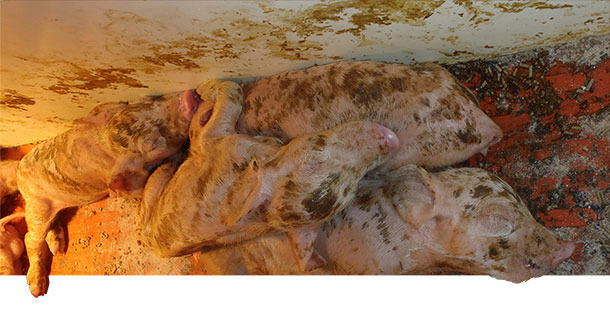
Photo 1. Severe scouring, dehydration, and high mortality in baby pigs.
Pigs older than 21 days:
- Diarrhea of short duration
- Some vomiting
- Mortality is minimal
Current Clinical Presentation
The latest U.S. Department of Agriculture (USDA) epidemiological outbreak curve suggest a point source outbreak with new outbreaks less frequent as we are approaching warmer weather.
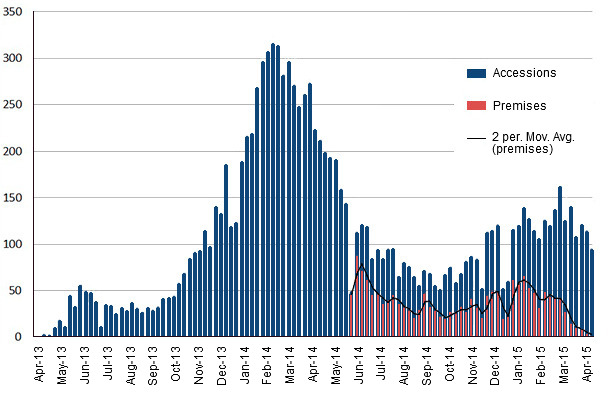
Figure 1. Evolution of PEDv outbreaks. Number of accessions, premises and premises moving average.
Source: American Association of Swine Veterinarians (Last updated 4/30/2015)
From a clinical perspective, there have been some slight changes in the clinical presentation of PEDv. The virus has been confirmed in 31 of 50 U.S. states (62%) and includes all states with significant pig production. It is estimated that 55 – 60% of U.S. commercial breeding herds have been exposed to PEDv. This is important as the disease is now endemic and thus the overall immunity of the U.S. breeding herd population is significantly different (varying levels of herd immunity) than when it was first introduced (100% naïve). The clinical presentation has also been complicated by the discovery of porcine delta coronavirus (PDCov), which can be found in conjunction with PEDv and is significantly much milder than PEDv, as well as at least three different “strains” of PEDv. It is important to note that there is no know cross protection between PEDv (genus: Alphacoronavirus), TGEv (genus: Alphacoronavirus), and PDCov (genus: Deltacoronavirus).
In regards to the identification of different “strains” for PEDv it is important to remember the following:
- Currently only 1 serotype of PEDv is recognized – this means that immunologically we have not identified differences between isolates/strains.
- Clinically there appears to be two different presentations:
- Original PEDv strain – high virulence as described in the first part of this article.
- Variant PEDv strain – this appears to be a much milder form of PEDv.
- Less clinical signs in adults
- Significantly less mortality in baby pigs
Immunity to PEDv appears to be short lived and likely just a few months in duration. We currently do not have a good way to measure protective immunity. As such we are entering a period with many unknowns.
- We have some sow herds with chronic PEDv (maybe ~10% of breeding herds).
- Weaned piglets still shed PEDv.
- Scouring still present in some baby pig litters.
- No scouring in sows.
- Number of pigs weaned will only reach 80-85% of their pre- PEDv productivity.
- Many chronic herds have successfully used PED vaccine to stabilize the herd.
- We have afew sow herds with re-breaks (maybe ~3-5% of herds).
- Re-breaks are significantly less severe.
- Some “re-breaks” have been attributed to PDCov.
- Re-breaks seem to occur 6 months to over 1 year after initial outbreak.
- Many re-breaks seem to be shorter in duration although recently there seems to be some that re-establish themselves as chronic problems.
- Re-breaks appear to affect mostly gilts and their litters.
- Concern that due to short duration of immunity, the number of re-breaks may significantly increase, especially this next winter when the virus survives in the environment better.
We have learned a lot about PEDv in just 2 years, but unfortunately there still is a lot more to learn. We still do not understand what risk factors make a herd become chronic or what risk factors make a herd re-break. These are questions we hope we can answer sometime in the near future.